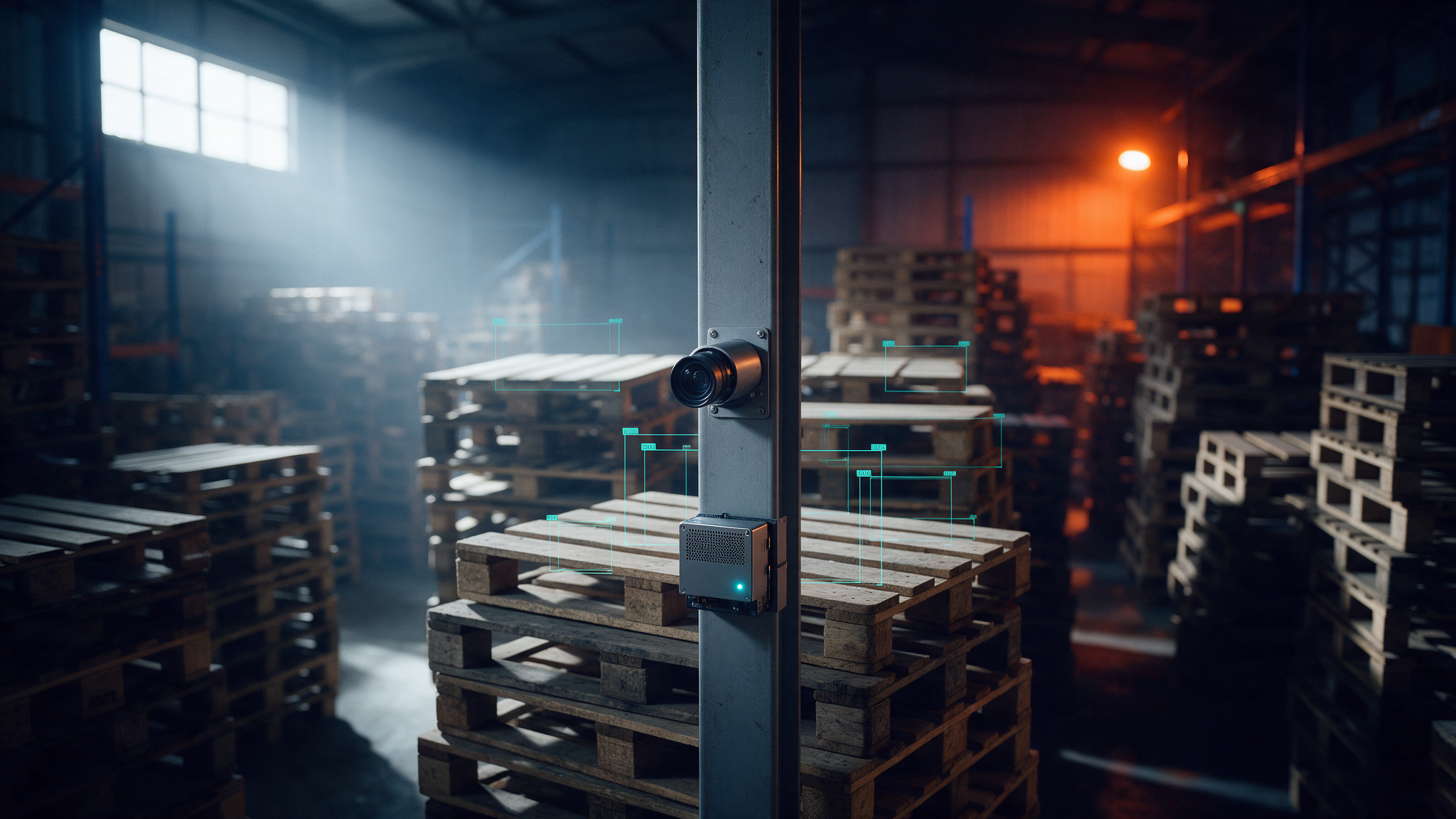

Edge AI computer vision runs inference directly on a local device instead of sending video to the cloud, which makes it usable in warehouses with no reliable internet connection. In one Azati engagement, an offline computer vision system running on NVIDIA Jetson replaced manual pallet counting at ≥97% accuracy under real warehouse conditions. Namely, cluttered stacks, mixed lighting, multiple camera feeds, and no cloud connectivity required for inference.
Key takeaways
- When reliable connectivity is unavailable, and real-time processing must continue, inference needs to run locally.
- Continuous video upload to the cloud is also often impractical on its own terms: it’s bandwidth-heavy and adds latency a real-time counting system can’t absorb.
- Azati’s offline pallet-counting system reached ≥97% accuracy, 5x faster throughput than manual counting, and a 65% reduction in manual counting effort.
- The model was trained on real images from the client’s own cameras (300–400 images collected daily) rather than a generic public dataset.
- The design can be assessed for expansion to additional cameras or zones, subject to edge-device capacity and performance testing.
Why can’t the warehouse just send video to the cloud?
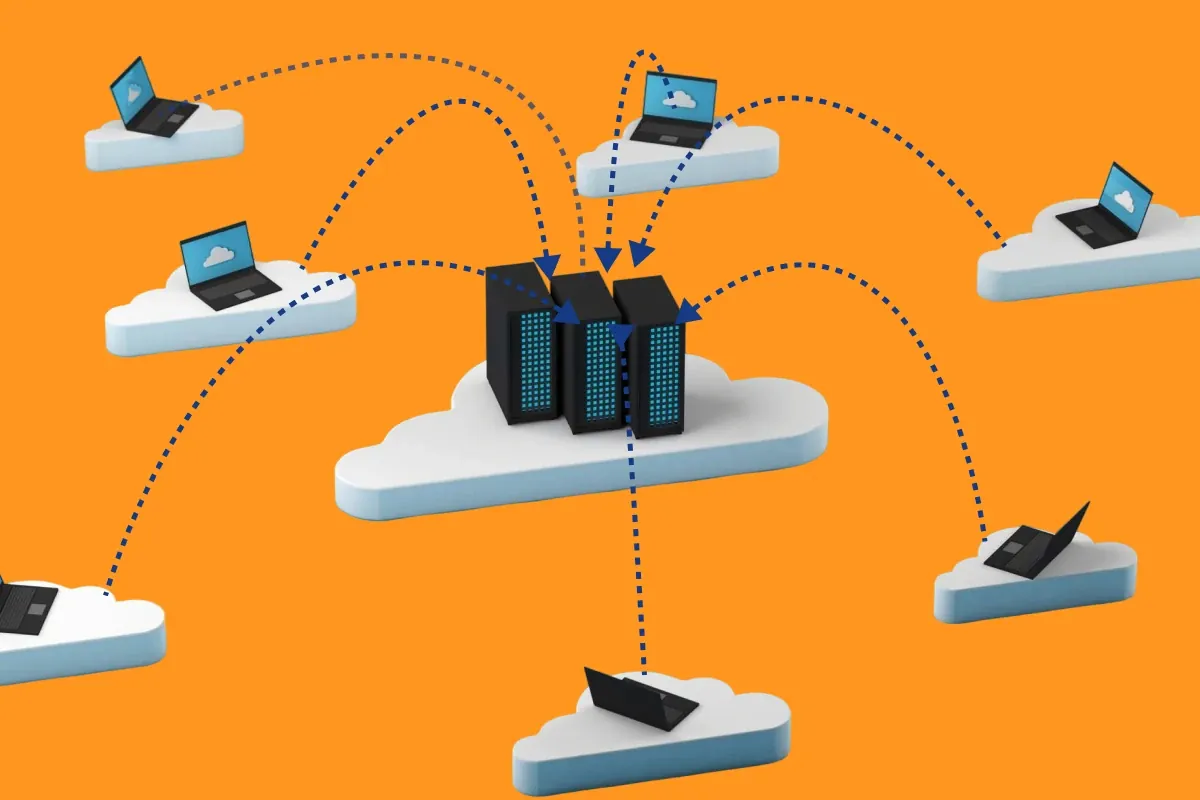
Two separate problems, not one. The first is connectivity: a facility with limited or no reliable internet access simply doesn’t have a stable enough connection to stream multiple live camera feeds anywhere. The second is more easily missed. Even where connectivity is fine, continuously uploading high-resolution video from several cameras is expensive and slow. Meaning, the round trip of upload, cloud inference, and response adds latency that a real-time counting system can’t tolerate.
NVIDIA makes the same point about running models directly on Jetson hardware rather than through an external API: processing locally means data never leaves the device, and it eliminates the network bottleneck rather than just making it faster. For a warehouse, that’s not a performance optimization. It’s the difference between an architecture that can operate under those conditions and one that depends on a reliable network connection.
What does an offline computer vision system actually have to handle?
Running inference without internet access solves the connectivity problem. Still, it doesn’t solve the harder one: making the vision model accurate enough to trust under conditions a lab-trained model rarely sees.
Three things make warehouse pallet counting genuinely difficult, not just offline:
- Clutter and occlusion. Pallets in an active facility are rarely arranged in a neat, orderly grid. They’re stacked irregularly, overlapping, and partially hidden behind each other. Exactly the condition where simple object-detection approaches miss counts or double-count.
- Inconsistent lighting. A single facility can have dramatically different lighting across loading docks, storage aisles, and production floors, and a model that works well under one lighting condition can degrade sharply under another.
- Multiple live camera feeds, processed in real time. A single-camera demo is a different engineering problem than reliably processing several simultaneous feeds on one edge device without the frame rate collapsing.
When does an edge AI computer vision warehouse system make sense?
Edge AI computer vision makes sense when a warehouse needs timely visual processing but sending video to the cloud is impractical, too slow, or inconsistent with its data-handling requirements. It is particularly relevant when connectivity is unreliable, multiple cameras generate continuous video, or decisions need to be made close to where the footage is captured.
The trade-off is that local processing shifts more responsibility to the on-site hardware and its lifecycle management. Device capacity, power and environmental constraints, software maintenance, and the cost of expanding the deployment all matter.
If connectivity is reliable and video transfer is affordable, cloud processing may remain a reasonable alternative. The right choice depends on operational requirements and the total cost of architecture, not simply whether a warehouse has internet access.
How Azati built an offline pallet-counting system that works
Azati implemented the pallet-counting pipeline on NVIDIA Jetson hardware so video could be processed locally without relying on cloud connectivity for inference. The system combined object detection, object tracking, image preprocessing, and hardware-optimized inference to process multiple camera feeds under live warehouse conditions.
A key factor was training on images collected from the client’s own environment. The data reflected the facility’s camera angles, lighting, clutter, and pallet arrangements. These are the conditions that generic benchmark datasets may not represent. The edge AI inventory counting model and processing pipeline could therefore be evaluated against the environment in which the system was expected to operate.
In the deployed use case, the system achieved 97% pallet-counting accuracy, increased counting throughput fivefold compared with the manual process, and reduced manual counting effort by 65%.
These are results from a specific deployment, not universal performance guarantees. A new facility would need its camera setup, operating conditions, target objects, and performance requirements assessed before accuracy and throughput expectations could be established.
Is this only useful for pallet counting?
No. Similar edge-first patterns can support other visual inspection tasks, but each requires task-specific model development and validation. The model is useful where connectivity is unreliable and real-time visual checks matter: shelf-gap detection, parcel-condition inspection, or general asset tracking across a facility.
The pattern that transfers isn’t the specific object being counted. It’s running inference locally, training on real environment data rather than generic datasets, and designing for the lighting and clutter conditions the camera will actually see, not the ones a demo video shows.
Is your warehouse ready to scope an edge AI vision project?
Once local inference appears to meet operational requirements, the next step is to determine whether the project can be realistically scoped. The following questions help identify the information needed to estimate hardware requirements, validate model performance, and plan deployment.
- Does the facility have unreliable or no internet access at the point where the camera feeds need to be processed?
- Would continuous cloud video upload be too slow, too expensive, or both, even where connectivity exists?
- Does the object being detected get occluded, overlap, or sit in inconsistent lighting? Are there conditions a generic pre-trained model wasn’t built for?
- Will the system need to process more than one camera feed simultaneously, in real time?
- Is there a realistic path to collecting training images from the actual environment, not just a public dataset?
If most of these are true, offline edge inference is worth scoping before a cloud-based alternative.
Is offline computer vision right for your warehouse?
Edge AI is worth evaluating when a warehouse needs continuous visual processing but cannot depend on reliable connectivity, or when streaming video to external infrastructure creates unacceptable latency, bandwidth demands, or data-handling constraints.
The right design depends on the number of camera feeds, required processing speed, operating conditions, and the quality of representative training data. These factors should be assessed before committing to hardware, accuracy targets, or a rollout plan.