Core system experts approaching retirement
Insurance modernization, automation, and AI for operational efficiency
Modernize claims, underwriting, and policy operations without replacing core insurance systems. Azati helps insurers reduce manual work, improve processing efficiency, and introduce AI into existing workflows while preserving critical business logic and regulatory controls. Stay GDPR-compliant by default and DORA-aware by design.
Assess your insurance modernization opportunities10 years
handling insurance software projects
Up to 85%
straight-through processing
30-60%
lower operational costs


Is modernization becoming your business priority?
The reason most insurers struggle isn’t lack of technology. It’s the whopping expenses behind the change within their existing systems. If these challenges sound familiar, modernization may deliver more value than adding another point solution:
Claims processing costs continue to rise despite digital initiatives
Underwriters spend overtime on routine reviews
Legacy systems slow down automation efforts
Customer data is fragmented across departments
AI initiatives are stalled by integration challenges
Compliance requirements increase operational complexity
Why insurance modernization initiatives often fail
As a seasoned insurance software partner, Azati has taken over projects that got stuck because:
Enterprises choose to replace too much at once
Poor-quality data was running across insurance systems’ modules
Workflow redesign initiatives were disconnected
AI was introduced before process readiness due to growing AI adoption among competitors
Lack of operational ownership
When internal teams are stretched too thin
Many insurers know what should be modernized but lack the engineering capacity to execute. Azati can work as an extension of your internal team, providing engineering capacity, modernization expertise, and delivery support without requiring a large internal transformation office. Common situations include:
Small IT teams supporting business-critical platforms
Backlogs growing faster than delivery capacity
Difficulty hiring insurance technology specialists
Modernization initiatives competing with daily operations
Challenges Azati handles while modernizing your insurance workflows
From operational and resource challenges to rising claim and loss-adjustment expenses to the retirement of legacy system experts, Azati knows the drill.
High operating costs
Manual claims handling, underwriting reviews, and policy servicing continue to consume significant operational resources.
#1
Increasing customer expectations
Policyholders expect digital self-service, faster decisions, and real-time communication.
#2
Growing data complexity
Claims, policy, telematics, documents, images, and third-party data create integration challenges.
#3
Increasing regulatory scrutiny
Insurers need explainable, auditable decision processes and stronger governance around automation and AI. This is why many are prudently prioritizing modernization before launching large-scale AI programs.
#4
Request insurance automation opportunity assessment
Detect operational bottlenecks, automation opportunities, and modernization risks before committing to a major transformation. Define where the project is likely to generate measurable operational gains.
What we assess
- Claims and underwriting workflows
- Legacy systems and data architecture
- AI readiness and integration constraints
What you receive
- Modernization opportunity matrix
- Claims automation candidates
- Underwriting workflow bottlenecks
- Projected savings and wins
- AI readiness score
- Phased implementation roadmap
Representative outcomes from Azati’s insurance projects
Note that the results vary by organization, process maturity, data quality, and implementation scope.
| Focus Area | Outcome |
|---|---|
| Claims & document processing | 85% straight-through processing |
| Self-service adoption | 80% portal utilization |
| Call center demand | 60% reduction |
| Underwriting workflows | 45% increase in straight-through processing |
| Data processing capacity | 2.5–5x increase |
| ETL performance | 80% reduction in runtime |
| Document processing cost | 52% reduction |
| Legacy system stability | Zero downtime during modernization |
Azati’s recent insurance modernization case studies
Azati typically works with insurers modernizing a specific operational area rather than undertaking a full core replacement program. The following projects illustrate how our team transformed the clients’ workflows via automation and AI, improving efficiency without rip-and-replace.
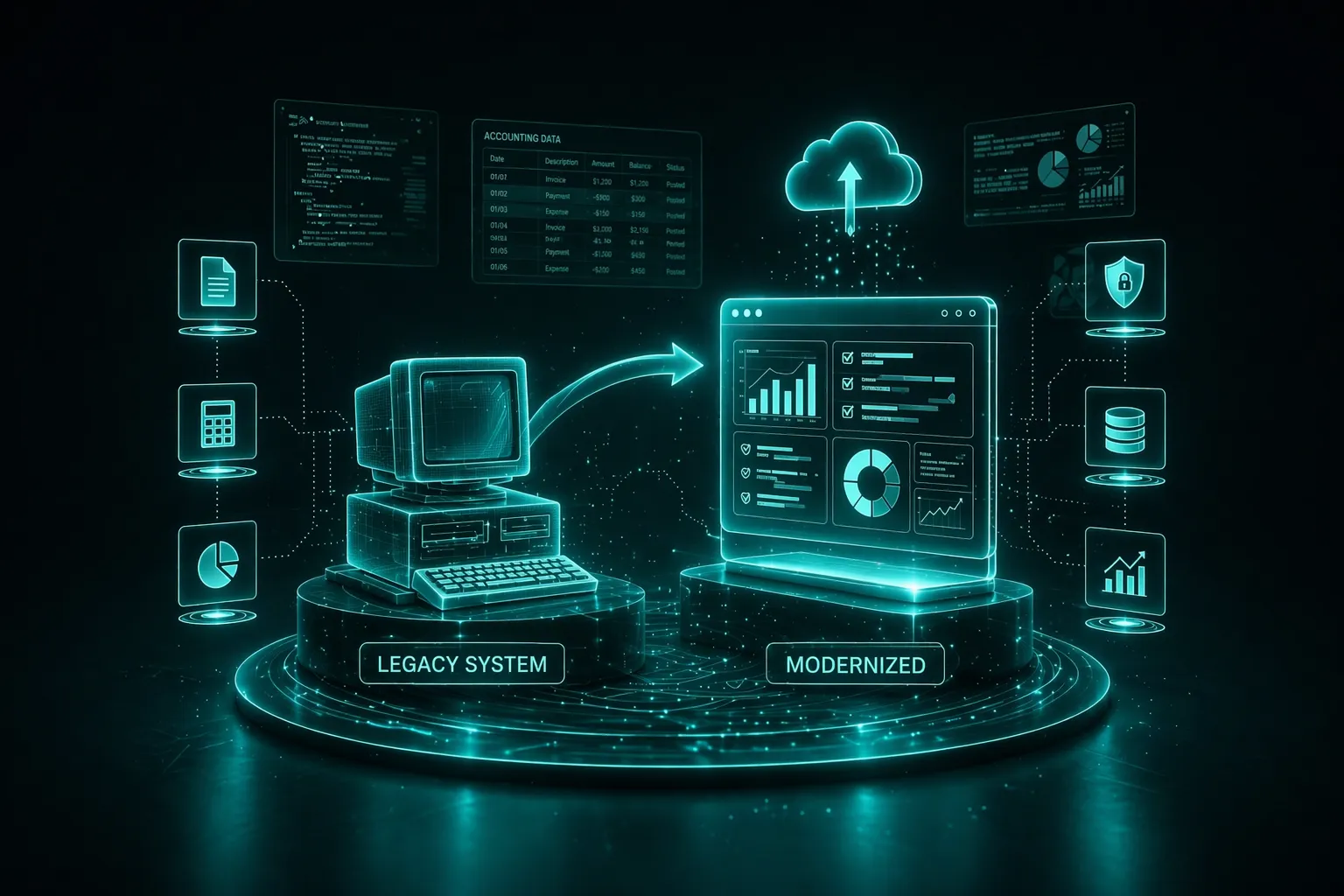
Legacy Accounting System Modernization
Business challenge
The client relied on a legacy accounting system built on outdated PHP architecture, which limited scalability, slowed down performance, and required significant manual effort for routine operations. The system struggled with a rigid monolithic structure, slow data processing and reporting, high dependency on manual workflows, and difficulty integrating with modern tools and services. Any attempt to modernize carried a high risk of disruption to business-critical financial operations.
Solution at a glance
Azati re-architected the legacy system into a modern, modular platform, ensuring continuity of operations while enabling future scalability and AI readiness. The modernization strategy focused on gradual refactoring instead of full replacement, introducing API-based integrations, improving data processing pipelines, and preserving business logic while upgrading architecture. The transition went without downtime, allowing the client to continue operations seamlessly.
How Azati solved the challenge
- Incremental modernization: Refactored the monolithic system step by step to reduce risk and avoid downtime.
- API layer introduction: Built REST APIs to enable integration with external systems and future AI components.
- Data workflow optimization: Improved data handling and processing speed across accounting operations.
- Manual process reduction: Identified and automated repetitive accounting tasks to reduce operational overhead.
- System stabilization: Ensured consistent performance and reliability during and after modernization.
Business outcome
- Modernized Architecture: Transition from a legacy monolith to a more flexible, maintainable system architecture.
- Improved performance: Faster data processing and reporting across accounting workflows.
- Integration-ready platform: API-first approach enabling future integrations and AI adoption.
- Reduced operational load: Less manual work required for routine accounting processes.
- Zero-downtime migration: Continuous system availability during the entire modernization process.

AI workflow automation for invoice and document processing
Business challenge
A shared mission-critical service center processed 40,000+ documents monthly, yet relied on manual review and error-prone legacy OCR. The workflows were drowned in manual effort and SLA delays. The challenge was to keep the existing SAP and document management infrastructure. No replacing, no rebuilds.
Solution at a glance
Azati crafted AI workflow automation middleware that integrates with the legacy SAP and DMS infrastructure through pre-built connectors. The project’s scope was to build and operate the solution from scratch, so Azati owns extraction accuracy, uptime SLA, and non-stop improvement as the core delivery model, not optional maintenance.
How Azati solved the challenge
- Multi-format doc ingestion and classification
- AI-assisted field extraction with confidence scoring
- Human-in-the-loop workflow for uncertain decisions
- AI process automation, including monthly costs and accuracy reports
Business outcome
- Multi-channel doc ingestion capability (PDF, TIFF, DOCX, XML, EDI)
- SAP REST API integration using master data matching
- Document-level immutable audit trail with GDPR compliance
- Operations dashboard with cost per document visibility

Insurance MDM and CRM modernization platform
Business challenge
A large insurance organization struggled with fragmented customer information distributed across multiple departments and disconnected applications. Sales, marketing, customer support, and operational teams relied on separate systems that stored overlapping and often inconsistent customer records.
As the business expanded, manual data consolidation became increasingly time-consuming and error-prone. Teams lacked a unified customer view, reporting required significant manual effort, and business processes varied across departments. The organization needed a centralized platform capable of improving customer engagement while establishing consistent and trustworthy master data across the enterprise.
Solution at a glance
Azati implemented an integrated CRM and Master Data Management (MDM) platform that consolidated customer, policy, and product information into a single source of truth. The solution automated data synchronization, standardized business processes, enabled real-time performance monitoring, and replaced multiple disconnected legacy systems.
The platform improved operational efficiency, increased reporting capacity, reduced software costs, and provided a scalable foundation for future business growth.
How Azati solved the challenge
- Unified customer data platform: Developed a centralized CRM system that consolidated customer information from multiple departments, databases, and legacy applications into a single reliable repository.
- Master data management integration: Implemented MDM capabilities to maintain authoritative customer, policy, and product records while ensuring consistency across all connected business systems.
- Automated data synchronization: Built automated processes for data integration, validation, standardization, and deduplication, eliminating manual consolidation activities and improving data quality.
- Business process standardization: Aligned sales, marketing, customer service, and operational workflows around common processes, rules, and templates to improve consistency across departments.
- Real-time reporting and analytics: Implemented dashboards and KPI monitoring capabilities that provided visibility into sales performance, campaign effectiveness, operational bottlenecks, and process efficiency.
- Legacy system consolidation: Replaced multiple disconnected applications with a unified platform, reducing licensing costs, simplifying user training, and lowering long-term maintenance overhead.
Business outcome
- Single source of truth for customer data: Customer information is centralized across departments, enabling employees to access accurate and consistent records throughout the customer lifecycle.
- Faster CRM operations: Automated workflows and data synchronization significantly reduced processing times for customer management, reporting, and operational activities.
- Improved business visibility: Real-time dashboards provide management teams with immediate access to performance metrics, bottlenecks, and operational trends.
- Lower operational costs: Consolidation of legacy systems reduced software licensing expenses and minimized the effort required to maintain multiple platforms.
- Better customer engagement: Sales, marketing, and support teams gained a complete customer view, enabling more personalized interactions and improved service quality.
- Scalable enterprise data foundation: The integrated CRM and MDM architecture established a reliable foundation for future modernization initiatives, analytics projects, and business application integrations.
Automated underwriting decision assistant
Business challenge
An insurance organization faced growing underwriting workloads driven by increasing application volumes and rising expectations for faster policy decisions. Underwriters spent significant time reviewing routine applications, creating processing bottlenecks and limiting their ability to focus on complex or high-risk submissions.
Decision quality also varied between reviewers, introducing inconsistency into the underwriting process. Although years of underwriting, policy, and claims data were available, much of this historical information remained underutilized during decision-making. The organization needed a way to increase throughput, improve consistency, and leverage historical data without removing human oversight from critical decisions.
Solution at a glance
Azati developed an AI-powered underwriting decision assistant that analyzes policy applications, assigns risk scores, and recommends whether an application should be approved, declined, or routed for manual review.
The solution uses machine learning models trained on historical underwriting and claims data to support faster, more consistent underwriting decisions. Configurable decision thresholds allow the insurer to balance automation and risk management while maintaining control over underwriting policies.
How Azati solved the challenge
- Machine learning decision engine: Developed a predictive model that evaluates incoming policy applications, generates risk scores, and recommends approval, decline, or manual review based on predefined decision criteria.
- Historical underwriting data utilization: Trained the system on historical applications, underwriting outcomes, policy records, and claims data, enabling the model to learn patterns associated with successful and unsuccessful applications.
- Automated application triage: Implemented automated classification of submissions into approval, review, and decline categories, reducing manual effort for routine underwriting decisions.
- Configurable risk thresholds: Designed flexible decision thresholds that allow underwriting teams to adjust automation levels according to business objectives, product lines, and risk appetite.
- Statistical decision support: Provided underwriters with historical performance insights and similar-case analysis to support informed decision-making and improve confidence in recommendations.
- Scalable integration architecture: Implemented a hybrid architecture using GraphQL and JSON APIs to support high-volume processing and seamless integration with existing insurance systems and workflows.
Business outcome
- Increased straight-through processing: A larger percentage of applications can be processed automatically, reducing delays and accelerating policy decisions without sacrificing oversight.
- Higher underwriting productivity: Underwriters spend less time on routine applications and can focus their expertise on complex, high-value, or high-risk cases.
- Greater application processing capacity: The organization significantly increased the volume of applications processed within existing operational resources.
- More consistent underwriting decisions: Machine learning recommendations help reduce variability between reviewers and promote standardized decision-making across underwriting teams.
- Data-driven risk assessment: Historical underwriting and claims data become an active part of the decision process, improving recommendation quality and operational insight.
- Flexible automation governance: Configurable thresholds allow business leaders to adjust automation levels while maintaining control over risk exposure and underwriting strategy.

Insurance Company Self-Service System
Business challenge
The client, an insurance company with a self-service web platform, faced complex workflow inconsistencies, data integrity risks, and limited QA coverage, which affected customer experience and operational efficiency. Multi-step processes like policy management and customer interactions were prone to errors, slowing down releases and increasing support overhead. Our task was to provide full-cycle quality assurance to stabilize the platform, ensure workflow accuracy, and improve release reliability.
Solution at a glance
Azati's QA team worked closely with the client to analyze insurance-specific workflows such as policy management, customer self-service actions, and backend integrations. We combined manual and automated testing, focusing on validating business logic, ensuring data consistency across systems, and covering real-world user scenarios. Special attention was given to multi-step workflows, integrations with backend systems (CRM, billing, databases), and edge cases that could impact compliance and customer trust.
How Azati solved the challenge
- Comprehensive Test Plan: Designed a full QA strategy covering functional, regression, integration, and usability testing, ensuring all insurance workflows and user scenarios were validated.
- Automated Regression Testing: Implemented automation for critical user journeys such as policy updates, account management, and data submission, reducing regression time and improving release speed.
- Manual Exploratory Testing: Focused on uncovering edge cases in complex workflows, including multi-step user interactions, data validation issues, and rare failure scenarios.
- Integration Testing: Validated interactions between the self-service platform and backend systems (CRM, billing, and data services), ensuring consistency and reliability across the ecosystem.
- Data Integrity Validation: Ensured accuracy and synchronization of customer and policy data across all stages of the workflow.
- QA Integration in CI/CD: Embedded QA processes into the development pipeline, enabling continuous testing and faster feedback.
Business outcome
- End-to-End Workflow Coverage: Comprehensive validation of insurance processes, including policy management, customer interactions, and backend operations.
- Automated Regression Suite: Fast verification of critical workflows after each release, enabling safer and quicker deployments.
- Integration Reliability: Stable communication between frontend and backend systems, reducing data inconsistencies and system errors.
- Risk-Based Bug Prioritization: Issues prioritized based on business impact (e.g., policy errors, data inconsistencies), ensuring critical problems were addressed first.
Set your modernization priorities right
Not sure where to start your modernization journey? Azati’s practice says, most insurers start with these initiatives:
- Claims intake automation
- FNOL workflow optimization
- Document processing
- Underwriting triage
- Customer self-service portals
- Policy servicing automation
- Legacy CRM and MDM modernization
- Data consolidation initiatives
Why insurance organizations engage Azati
Azati specializes in modernizing insurance operations without replacing core systems. Many insurers cannot justify multi-year rip-and-replace programs. The Azati team focuses on extracting operational gains from existing policy, claims, and underwriting platforms through targeted modernization, workflow automation, and AI augmentation.
- Focus on incremental, cost-effective modernization
- Azati helps avoid costly core replacement projects
- Choose phased modernization
- Improve operational efficiency first
- Introduce AI after process readiness is established
- Extend limited internal engineering capacity
Delivery track record
Insurance domain experience
The Azati team has firsthand experience building and modernizing policy administration solutions, underwriting and claims operations automation platforms, billing and customer self-service systems, insurance analytics and data management apps.
Experience with regulated environments
Azati is currently under ISO 27001, 27701, and 9001 accreditation, and adheres to DevOps and DevSecOps practices across delivery. We analyze legacy COBOL and monolithic systems’ technical debt, and review architectures against EU AI Act, DORA, and NIS2 requirements.
Technical depth
We at Azati build insurance platforms using ETL ecosystems, cloud platforms, AI and machine learning tech, managed AI, with efficient Java, Python, Oracle, MSSQL, and PHP frameworks.
Client testimonial
They are good and accountable. They will work with us to resolve issues.

How Azati helps insurers improve operational efficiency
Modernize legacy without replacing core systems
Avoid rip-and-replace while minimizing implementation risk and time-to-value. For insurance platforms underlying years of embedded business logic, Azati handles:
- System stabilization
- Integrations improvement
- Architecture modernization
- High-friction workflows automation
Reduce doc work, manual claims, and handling costs
Boost throughput while reducing manual effort. To help your claims teams process large volumes of invoices, forms, attachments, supporting evidence, and correspondence, Azati builds solutions that:
- Classify, extract, validate, and route information
- Preserve human review where required
- Improve self-service adoption
Increase underwriting throughput and efficiency
Speed up processing, establish more consistent workflows. Azati enables your underwriters to focus on complex decisions, not repetitive administrative tasks.
- Automate intake
- Prioritize submissions
- Support decision-making
- Operationalize predictive models
Build trusted insurance data foundations
Bolster visibility and decision-making reliability. To rule out the struggle with disconnected systems and inconsistent data, Azati supports:
- Data consolidation
- MDM initiatives
- ETL modernization
- Analytics platforms
- Forecasting and reporting
Azati’s typical insurance modernization engagement
| Phase | Objective |
|---|---|
| Assess operations | Identify bottlenecks and modernization risks |
| Select priority workflow | Focus on highest-value opportunity |
| Deliver pilot | Validate operational and financial impact |
| Scale automation | Extend proven workflows |
| Optimize performance | Improve efficiency using production data |
Azati offers flexible engagement options
Whether you need strategic guidance, additional engineering capacity, or end-to-end delivery, Azati adapts to your modernization goals and internal resources.
| Situation | How Azati helps |
|---|---|
| Need a modernization roadmap before committing to implementation | Assessment and roadmap engagements |
| Internal team lacks specialized insurance engineering expertise | Embedded engineers |
| Need additional delivery capacity without expanding headcount | Dedicated modernization teams |
| Have a clearly defined modernization initiative | Project-based delivery |
Discuss your preferred engagement requirements
Opt for the model that sits well with you and drop a line to describe your workflow specifics. Azati is one click away.
Schedule a preliminary guidance callFrequently asked questions
Most often Azati often works with:
- Regional and national insurers
- Specialty insurers
- Mutual insurers
- Insurance groups modernizing a specific business unit
- Organizations operating legacy policy, claims, or customer systems
Incremental modernization can improve security, integrations, performance, and maintainability while preserving existing business logic.
Document classification, claims intake, underwriting support, policy servicing, customer support, and reporting workflows are common starting points.
Most successful implementations augment human decision-making rather than replace it, especially in regulated environments.
Automation, workflow redesign, document processing, and self-service capabilities often provide the fastest operational gains.
Assess data quality, workflow readiness, governance requirements, and integration constraints before selecting AI technologies.
Last updated
