


Monthly retainer
Predictable low-touch coverage, re-indexing and tuning as content changes.
Build a governed knowledge layer across your organization's documents, portals, applications, and databases. Azati combines agentic retrieval, hybrid search, metadata enrichment, and grounded generation to give AI agents reliable access to enterprise knowledge.
Turn scattered enterprise knowledge, from scanned manuals and technical documents to portals, databases, and internal applications, into a governed retrieval layer that AI agents can use, with answers grounded in your source content and traceable to the original evidence.
How it worksAzati's own website runs on the same search core. You can test multilingual queries and see answers grounded in the site's existing content, with citations to the source pages.
Two structural differences: AI-accelerated delivery as the core operating model, not a layer bolted on top; and smaller, specialist-led teams with wider ownership, fewer handoffs, faster decisions.
Azati builds the retrieval and knowledge layer that makes this information usable by people, AI assistants, and purpose-built agents, without requiring you to move everything into a new system. Proven on patent and biomedical terminology, the densest, least forgiving content there is. If it holds up there, it holds up on your contracts, manuals, and SOPs.
We don't quote one accuracy number for AI search in general. Search accuracy depends on the corpus, domain, query types, and quality of the underlying content, so it should be measured against your data. We'll show you the evaluation approach during the scoping call.
Schedule the scoping callContent investment, without content findability
The strongest fit is an organization with a large or complex body of valuable content that conventional search struggles to surface, particularly when that content is distributed across websites, portals, intranets, documents, or internal knowledge bases.
Organizations accumulate case studies, SOPs, technical documentation, product specs, and internal knowledge for years, and then rely on keyword search that returns whatever page happens to contain the exact word typed in. Same root cause everywhere: search that ranks by statistical word-match and leaves the human to filter, instead of search that understands what's actually being asked.
The cost shows up in different places depending on where the content lives:
"I searched for our GDPR case study and got a 2019 blog post instead.” Relevant content exists, but conventional search fails to surface it. Prospects may leave, while sales teams repeat information that is already published.
A German-speaking employee may struggle to find relevant information when the source content is in English. An operator on a night shift may also need information buried in a scanned manual or document full of screenshots. In both cases, the problem is not necessarily missing knowledge. It is finding and interpreting the available content.
"We built a knowledge base. Support still says nobody finds the right article.” A knowledge base only reduces support effort when users can reliably locate the information they need.
Retrieval is the foundation. Azati separates knowledge retrieval from the language model, so the system can be evaluated, controlled, and adapted independently of the model generating the answer.
The pipeline prepares enterprise content, interprets each request, selects the appropriate retrieval strategy, combines semantic and exact-match signals, reranks the evidence, and generates an answer only from the retrieved sources. Confidence thresholds provide an explicit fallback when the available evidence is insufficient.
The retrieval layer does not have to end with a search box. The same governed enterprise knowledge can support purpose-built AI applications and agents.
Give employees, customers, or partners direct access to grounded answers across complex documentation and knowledge repositories.
Add a source-grounded assistant to an existing portal, application, intranet, or field workflow without creating a separate knowledge silo.
Build agents that retrieve enterprise knowledge as part of a larger task: reviewing technical documentation, assisting support teams, navigating procedures, preparing research, or guiding users through domain-specific workflows.
Combine retrieval, query planning, reranking, source evaluation, and LLM reasoning so agents work from controlled enterprise knowledge rather than relying only on their general training.
Connect retrieval to the systems and rules around the knowledge: permissions, escalation paths, approval steps, APIs, and existing business processes.


This isn't a life-sciences tool that happens to work elsewhere. The underlying search core was proven on patent and genomic data because that's the hardest version of the problem, not because that's the only problem it solves.
Not every organization needs this. The ones that benefit share a shape: content that's valuable but scattered, hard to search by keyword, or too sensitive to hand to a public cloud AI tool. If your situation doesn't fit, we'll say so on the call.
Enterprise knowledge environmentsProspects who need to self-qualify before a sales call, or international visitors arriving in a language your content isn't written in. AI search returns the right case study or spec sheet, cited, on the first try. In the visitor's own language, without a translation project.
Fit signal: rich content, complex product lines, or an audience that leaves rather than calls when search fails.
Said plainly, upfront, because it saves a scoping call from becoming a surprise later.
PDFs (text and scanned), web pages, DOCX/XLSX, images and screenshots (via vision/OCR, not skipped), and connectors to your document stores for the intranet/portal tier. Public website content is crawled directly; internal sources require an ingestion path you control.
Access to the content (crawl access, an export, or a connector), a decision on hosting (see Configurability), and a decision on identity and permissions for portal/intranet deployments. Preserving your existing access rights (AD/LDAP, RBAC) so a shift worker can't retrieve an executive-only document is real engineering work, not a checkbox; it's scoped explicitly, not assumed included.
The platform provides the retrieval, grounding, permissions, evaluation, and guardrails that AI applications and agents need to work with an organization's own knowledge. Search is one application of that infrastructure; it is not the entire product.
The website package targets up to ~5,000 public pages. Larger content estates, multiple domains, multi-tenant setups, or full internal knowledge bases are scoped as an extended engagement on the same platform.
The platform is one core engine; what changes per client is configuration, not the core.
Off-topic refusal (it won't answer questions unrelated to your content), an allow/deny list to keep sensitive pages out of the answer surface even if they exist in the index, and prompt-injection defenses so visitors, including competitors probing your site, can't trick the system into surfacing what it shouldn't.
Below the delivery threshold, the system says "I didn't find a confident answer" instead of guessing, and can route the question to the right internal team by your rules, with a pre-drafted message ready to send, turning a dead end into a handled request instead of a lost visitor or a frustrated employee.
Azati EU infrastructure, your own cloud tenant (AWS/Azure/GCP), or on-premise/air-gapped deployment for organizations that cannot send data to any external service. This is a genuine deployment option we've delivered elsewhere, not a roadmap item.
Proven in production. A secure on-premises deployment (vLLM, Open WebUI, RAG) for a confidential-search environment, with data kept within the client's controlled infrastructure. 60% faster information retrieval and a 75% reduction in search time for a confidential-search client.
External LLM APIs by default for fastest time-to-value, with a fully self-hosted, open-source model option (zero data egress) for environments where no query or document content can leave the perimeter, ever. Self-hosted model options are available when content must remain within client-controlled infrastructure rather than being sent to a third-party AI provider.
Widget UI matched to your visual identity; multilingual query understanding so a question in any language finds English (or any-language) source content and answers back in the language it was asked.
What you receive depends on the surface, but the core is constant.
Azati's delivery model is build-and-operate, not build-and-hand-off. The engineers who scope the work are the same engineers who run it in production, which is also why the Maintenance options below default to Azati staying involved rather than a cold handover.
Search quality degrades as your content grows and the world changes. We say this upfront rather than let you find out after support ends. Content re-indexing runs on a webhook from your CMS or document store by default, so newly published content is searchable within hours, not weeks.
Included production support (three months on the website package) covers initial drift as real users hit edge cases. After that, three paths, all supported, none forced:
Predictable low-touch coverage, re-indexing and tuning as content changes.
Azati operates the full system under an SLA.
A runbook, monitoring setup, and update procedures, if your team wants to run it themselves.
Framed as business outcomes, not engineering trivia, because the buyer of this isn't the engineer evaluating the algorithm. It's the executive who owns the cost of people not finding answers.
Index-time (continuous, before any query runs)
Content becomes searchable before anyone asks a question. PDFs (text and scanned), web pages, DOCX/XLSX, and images are parsed, OCR'd where needed, chunked, and indexed, including documents that are scans with a stamp on them, not clean text. This is the stage most off-the-shelf search tools quietly assume away, and the stage most enterprise content actually breaks on.
Query-time (per search): Query → Understand and prepare → Search core → Refine and explain → Answer
Semantic retrieval finds the right case study even when the visitor's words don't match your page's words. The FinOps page gets found by someone searching "reducing cloud spend."
Any language in, matching language out, against a single content estate. No parallel indices, no localization backlog blocking search from working today.
Every claim is anchored to a source you own and can click into. If it's not confident, it says so. It is designed to answer from retrieved source content and return an explicit fallback when the available evidence does not meet the configured confidence threshold.
Off-topic refusal, allow/deny lists, and prompt-injection defenses mean the search surface can't be walked into revealing what it shouldn't, by a competitor or by an employee without the right access.
When there's no confident answer, the system doesn't just say "not found". It routes the question to the right team with a drafted message, on your rules. That's the difference between a lost visitor and a captured lead, or a frustrated employee and a logged request.
Every query is traceable through the pipeline: what was retrieved, how it was ranked, what the final answer was grounded in. That's what makes this defensible in a regulated environment, not just a good demo.
Knowing the edge is worth more than a capability list, and it's what tells you whether to call us or someone else.
Azati's core offering is the enterprise knowledge and retrieval layer behind AI applications. It can power direct search and cited answers, but it can also serve as the knowledge foundation for purpose-built assistants and agents.
The difference matters: the system is engineered around your content, retrieval requirements, permissions, deployment constraints, and business workflow rather than around an open-ended chat experience.
If you're fully inside Microsoft 365 with a well-organized SharePoint and no data-residency constraint, a general copilot may already cover you. Azati will tell you that on the call rather than sell past it.
Content changes, the world changes, search quality drifts. Azati says what happens after support ends instead of leaving it implicit.
Azati preserves and respects the access model you already have. We don't redesign your identity and access management as part of this engagement.
Base packages target defined content volumes. Very large or multi-tenant estates are a separately scoped engagement on the same platform.
If the underlying content doesn't exist or is wrong, search can only surface it faster. It can't invent what isn't there.
In a 30-minute scoping call, an Azati engineering lead will look at your content, search requirements, deployment constraints, and expected scale. You'll get a practical view of whether AI search fits the problem, and what would need to be validated before implementation.
Discuss your search requirementsWe don't describe search systems we could build. We run one. Azati's own website uses the same search core described on this page, alongside search and document-intelligence systems developed for regulated and data-intensive environments.
Azati combines content preparation, hybrid retrieval, reranking, grounded answer generation, citations, confidence controls, and deployment options into one search pipeline.
Distributed, sensitive, or poorly structured for conventional keyword search, and when the organization needs to see where an answer came from.
It combines hybrid full-text search, BM25, vector semantic retrieval, and re-ranking across every field of a patent, not just the claims.
We're specific about which parts are shipped and which are proven in POC, because a patent office and a CIO ask the same question: show me the number, not the adjective.
Ambiguous identifiers, inconsistent naming, dense cross-references, and zero tolerance for a missed match. Most enterprise content is easier than this, not harder. A search core Azati tuned for sequence IDs and patent claims handles SOPs, contracts, and product manuals without needing to be re-architected for "easier" data. It's already been stress-tested past that bar.
This sequence-search platform went on to power patent-expert workflows at Clarivate, with Azati as the technical delivery partner.
| Case | Result |
|---|---|
| Engineering-document intelligence, nine-year partnership with digatex.com | 70% faster delivery, turning dense technical archives into structured, searchable data |
| Bioinformatics semantic search | 27ms per query, 98% tagging confidence with custom word2vec model Retraining on new datasets in ~3 minutes |
| Services marketplace, NLP-powered local search | +272% search-driven activity |
| Recruitment platform, fuzzy skill matching | +27% relevant candidates surfaced |
| Inventory search, 600k+ SKUs | Sub-second similar-item fallback when no exact match exists |
| Sports-data platform, 5M+ records | 92% semantic search accuracy >70% reduction in manual oversight |
| Search stack we run | Elasticsearch · Solr · pgvector · vector DBs · word2vec · LLM embeddings · LangGraph · Llama · OpenAI · Redis · CUDA · BLAST+ |



A biotechnology company struggled to obtain meaningful BLAST results for short DNA/RNA primers under 20 bases. Missing matches and incomplete alignments slowed genomic analysis and required researchers to manually tune search parameters.
Azati customized the BLAST algorithm for short-sequence research by adjusting sensitivity thresholds, introducing dynamic parameter tuning, and improving filtering logic. The solution automated configuration based on query length while reducing false negatives in primer-based searches.
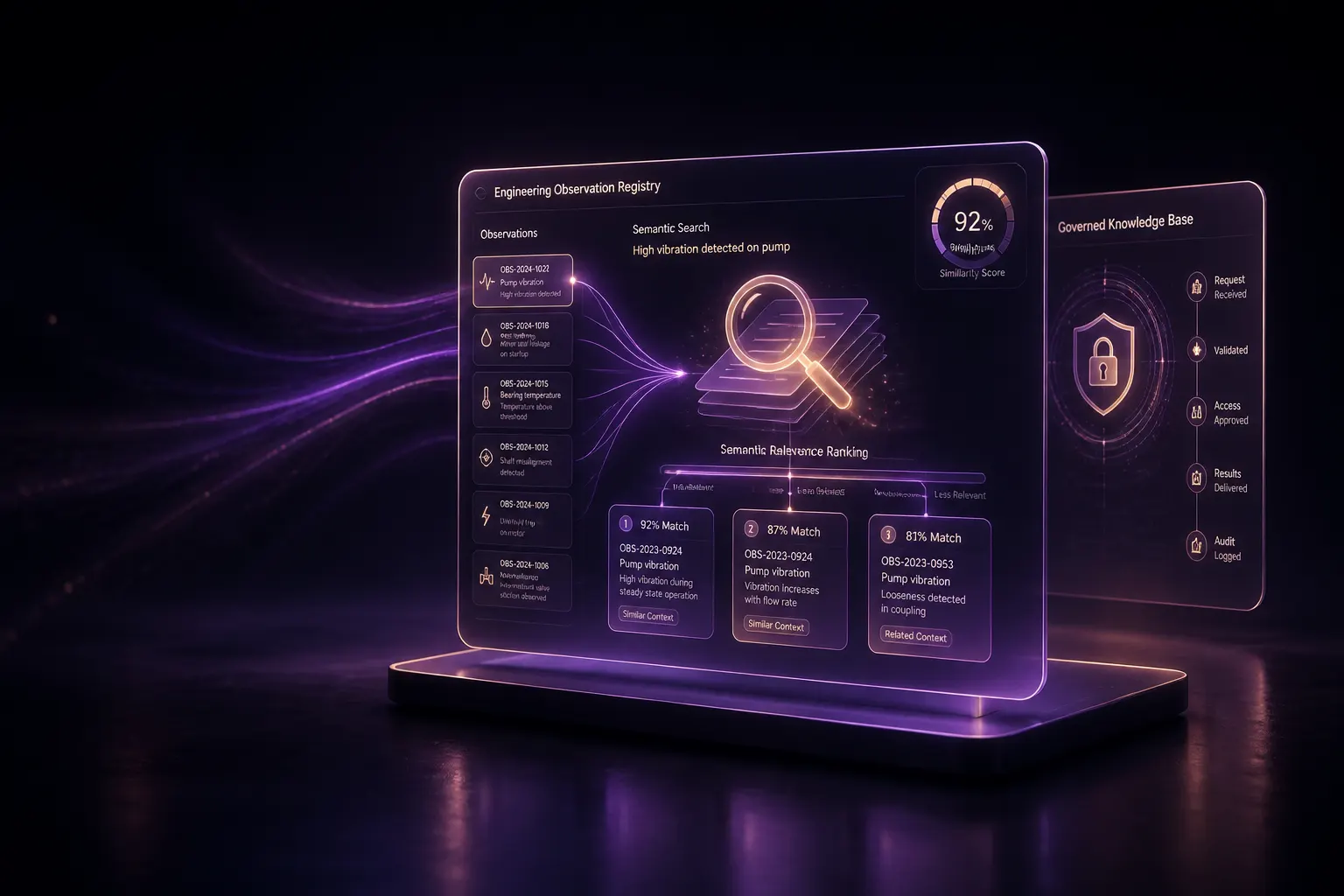
Engineering teams accumulated valuable knowledge across capital projects, but finding comparable historical observations required manual searches through project records, reviews, and technical documentation. The client needed faster knowledge retrieval without introducing a separate tool or disrupting established engineering workflows.
Azati embedded AI-powered semantic search directly into the client's existing capital project platform. The solution combines domain-restricted retrieval, LLM orchestration, and contextual recommendations to help experts find relevant historical observations within their existing review workflow.

A bioinformatics company needed to improve the accuracy and speed of searches across large, complex scientific datasets. Inconsistent blood sample descriptions, manual tagging, synonyms, and disease-name variations made conventional search slow and unreliable, with some queries taking several minutes.
Azati developed a machine learning-powered semantic search engine that automatically tags blood samples, interprets unstructured queries, recognizes synonyms and terminology variations, and retrieves relevant results in milliseconds. A custom Word2Vec model, Redis caching, and RESTful microservices provided a scalable foundation that could adapt to new datasets.
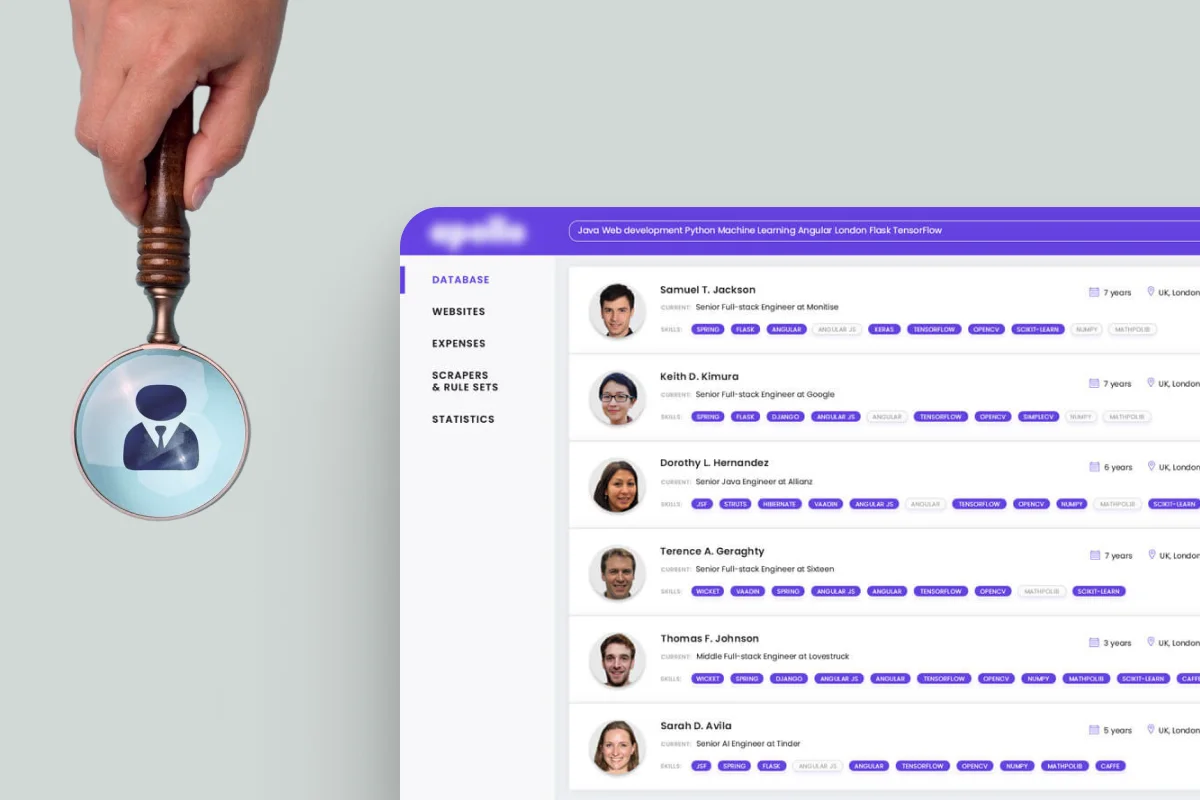
A New Jersey staffing agency needed to reduce the manual effort involved in sourcing and evaluating candidates across multiple websites. Resume data was fragmented and inconsistent, while incomplete profiles and complex technical skills made it difficult to identify suitable candidates efficiently.
Azati developed a cloud-based recruitment search platform that automatically collects and consolidates candidate data, structures incomplete resumes, predicts relevant skills, and enables fast search across enriched candidate profiles. A network of microservices supported large-scale data collection and machine learning-based candidate classification.

A Brazilian auto parts retailer operated an online catalog with more than 500,000 parts and 100,000 accessories, but its legacy search struggled with the scale and complexity of the inventory. Product data was distributed across spreadsheets, databases, files, and APIs, while customers needed to find specific parts even when their queries did not exactly match catalog entries.
Azati developed an AI-powered inventory search engine that unified fragmented catalog data, enriched parts with searchable attributes, and matched user queries against product characteristics. When an exact match was unavailable, the engine could identify similar parts and accessories, while in-memory processing enabled search results in under one second.

An international sport organization needed to centralize athlete and event data streaming in from live feeds, official results APIs, media outlets, CSVs, XML, HTML pages, and historical archives – with inconsistent naming conventions and no consistent identifiers linking the same athlete or event across sources. Every update, correction, and conflict was reviewed manually, a process that couldn't scale as feed volume grew, leaving administrators no automated way to catch anomalies before they reached a report or partner feed.
Azati built a four-layer platform: distributed ETL pipelines on Apache Spark for batch and streaming ingestion, a containerized microservices layer for entity linking and deduplication, an AI-assisted enrichment stage using NLP and embeddings for semantic search, and a governance hub with full versioning, conflict comparison, and audit trails.
Knowledge intelligence is the combination of enterprise knowledge, intelligent retrieval, contextual interpretation, and AI reasoning that allows people and AI systems to find, understand, and use an organization's own information.
Azati's Knowledge Intelligence platform provides this layer for enterprise websites, portals, applications, intranets, and AI agents.
Azati's knowledge intelligence platform is the enterprise knowledge and retrieval layer behind AI applications. It can provide direct search and cited answers, but it can also supply governed retrieval to purpose-built assistants and AI agents.
Unlike a generic copilot, it is engineered around the organization's own content, retrieval logic, permissions, domain terminology, deployment requirements, and source-grounding rules.
The search pipeline can support multilingual queries and answers, including cases where the query language differs from the source-content language. Supported languages and expected accuracy should be validated against the target corpus.
Grounded AI search can reduce unsupported answers by generating responses from retrieved source content and applying confidence thresholds. Azati's approach can return an explicit fallback when the available evidence is insufficient rather than forcing an answer.
AI search accuracy depends on the content corpus, domain, query types, retrieval configuration, and evaluation methodology, so there is no meaningful universal accuracy percentage. Azati evaluates search against the client's actual content and use cases rather than presenting a single generic accuracy number.
Organizations with substantial, valuable, or sensitive knowledge distributed across websites, portals, intranets, document repositories, applications, or databases, particularly where conventional search, fragmented knowledge bases, or generic AI tools cannot provide sufficiently relevant, grounded, or permission-aware retrieval.
Azati EU infrastructure (GDPR-native), your own cloud tenant, or fully on-premise/air-gapped for organizations that can't send data to any external service, including, where required, a self-hosted open-source model configuration with zero data egress to any third-party AI provider.
Azati can deliver a fixed-scope website in approximately 2–4 weeks. Enterprise portal, intranet, and application deployments usually require individual scoping because integrations, permissions, content volume, and infrastructure requirements vary.
That's the portal/intranet tier, scoped separately because it usually involves identity-aware search and non-text content (scans, drawings). Same platform, different, honestly-priced configuration.
Configuration, prompts, guardrail rules, brand-matched UI, and analytics belong to you. The underlying search platform is Azati IP, licensed for the engagement term. Source-code delivery is available as a separate arrangement.
Three options, no forced lock-in: a monthly retainer, a fully managed engagement on an SLA, or an in-house handover with a runbook and monitoring setup.
Last updated
