Modernizing complex .NET and SharePoint environments

Legacy Microsoft environments accumulate years of business logic, customizations, and technical debt. Azati helps enterprises modernize .NET applications, migrate SharePoint estates, and introduce Azure and AI capabilities without disrupting critical operations.

Discuss your modernization priorities
30+
SharePoint portals migrated & consolidated
100K+
Content entities migrated without data loss
US & EU
Legal entities

Why enterprises are modernizing Microsoft environments now

Modernization is no longer about replacing working systems. It is about ensuring they remain maintainable, secure, and adaptable for the next decade.

Several forces are converging:

  • Legacy .NET Framework systems are becoming increasingly expensive to maintain.
  • SharePoint 2013 and 2016 environments accumulate governance and customization debt over time.
  • Cloud-native architectures have become the default for scalability and resilience.
  • AI and automation initiatives expose limitations in monolithic applications.
  • Regulated organizations face growing operational resilience and compliance requirements.

The challenge:

The challenge is no longer keeping legacy Microsoft systems running. Enterprises need platforms that remain maintainable, cloud-compatible, and capable of supporting future automation and AI initiatives without introducing unnecessary risk.

How Azati uses the Microsoft Stack to resolve your business challenges

Modernize and stabilize legacy Microsoft environments

Enterprise Microsoft systems accumulate years of customizations, dependencies, and business rules. Azati helps organizations modernize these environments incrementally without disrupting critical operations.

Whether you're migrating SharePoint farms, upgrading .NET Framework applications, or untangling inherited architectures, we focus on reducing technical debt while preserving the business logic your organization depends on.

Typical engagements

  • SharePoint migration and portal consolidation

    Migrate SharePoint 2010/2013/2016 environments to Microsoft 365 while rebuilding governance, permissions, metadata, and navigation structures.

  • .NET Framework modernization

    Upgrade legacy ASP.NET and .NET Framework applications to modern .NET and cloud-native architectures.

  • Monolith decomposition

    Incrementally split tightly coupled applications into maintainable services without requiring a complete rewrite.

  • Legacy customization remediation

    Identify unsupported SharePoint customizations, workflows, web parts, and third-party dependencies before they create migration risks.

  • Enterprise document and content systems

    Modernize document-centric applications and line-of-business platforms while preserving existing workflows.

Technologies involved: .NET 8/9, ASP.NET Core, SharePoint Online, SPFx, Azure SQL, Entity Framework, GitHub Actions, Azure DevOps.

Azati specializes in Microsoft systems with history

Many modernization projects fail because the hardest part isn't technology. It's accumulated complexity:

  • Undocumented business rules
  • Inherited code from previous vendors
  • Years of SharePoint customizations
  • Fragmented governance
  • Dependencies no single team fully understands

Azati works inside these environments and helps enterprises modernize them incrementally instead of replacing them wholesale.

Who hires Azati for Microsoft stack work?

Enterprises modernizing legacy Microsoft platforms

  • .NET Framework applications
  • aging SharePoint estates
  • inherited code
  • technical debt slowing delivery

The Azati team that can work safely inside business-critical systems while modernizing them incrementally. We've mapped these environments before, including under strict security constraints.

Azati's related enterprise .NET and Microsoft projects

Enterprise SharePoint Migration & Portal Consolidation for Oil & Gas
Energy

Enterprise SharePoint Migration & Portal Consolidation for Oil & Gas

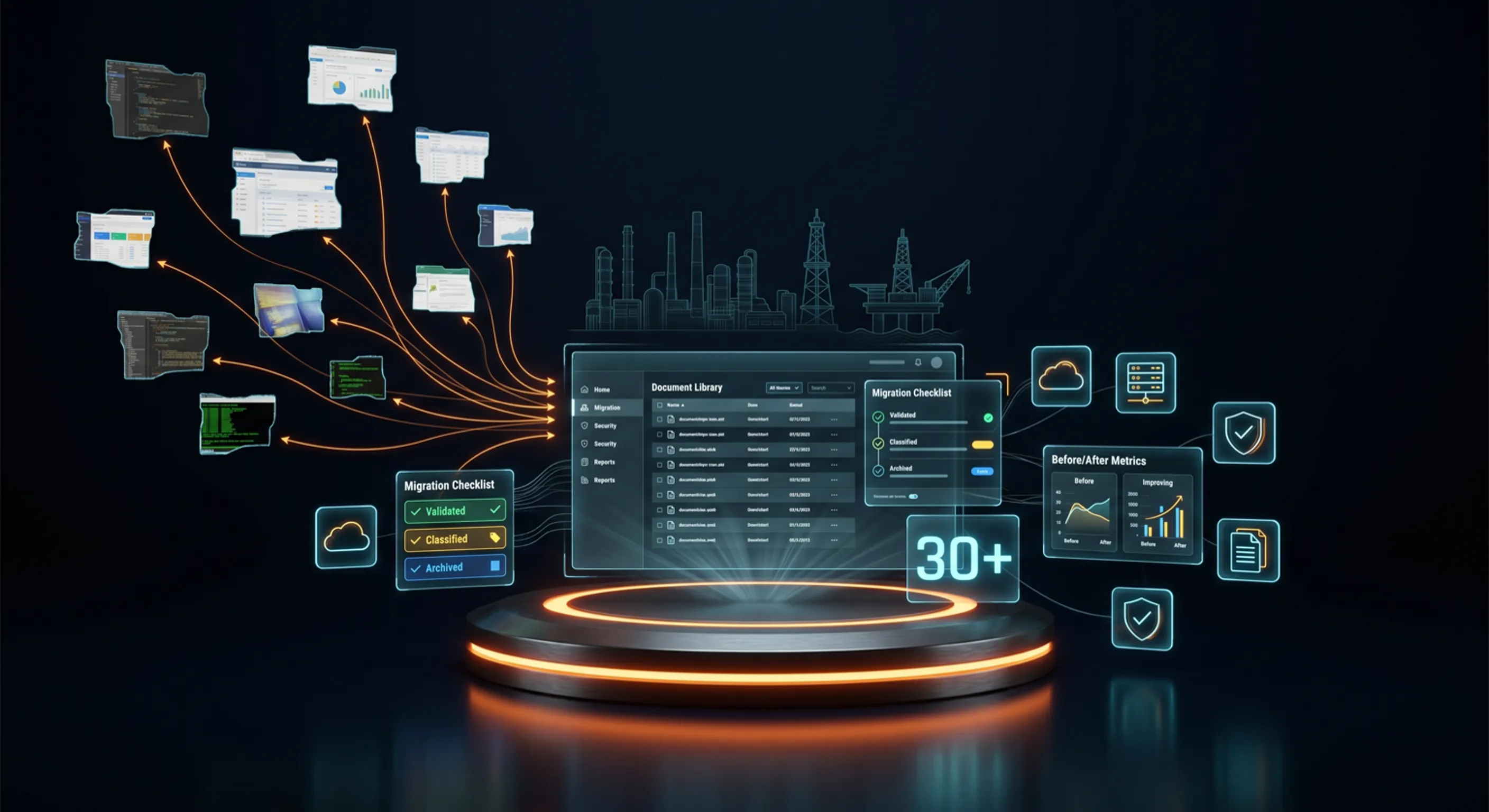
30+ Portals analyzed & classified
100K+ Content entities audited without data loss
+15% Undiscovered customizations vs. initial estimate
  • SharePoint
  • SharePoint Online
  • Incomand
  • Microsoft Excel
  • Microsoft Word

Business challenge

The client operated a distributed SharePoint infrastructure built over 10+ years, 30+ independently evolved departmental portals with fragmented navigation, duplicated and orphaned content, undocumented customizations, and dependency chains no single team fully understood. Previous migration attempts had stalled due to the sheer volume of unknown customizations and the complexity of coordinating content governance across regional departments. The environment imposed strict security constraints: isolated infrastructure, disabled clipboard, and secured remote access throughout the engagement.

Solution at a glance

Azati ran the end-to-end migration assessment and planning program: full inventory of all 30+ portals, content classification by type and ownership, customization compatibility audit, governance policy design, and a standardized migration validation framework enabling large-scale modernization planning. The team operated under enterprise-grade security constraints while maintaining full documentation standards throughout.

How Azati solved the challenge

  • Full portal inventory and content classification across 30+ departmental sites
  • Customization compatibility audit covering web parts, workflows, and third-party add-ins
  • Permission model mapping and governance policy design across regional departments
  • Stakeholder coordination framework for cross-departmental migration alignment

Business outcome

  • Standardized migration assessment framework applicable at enterprise scale
  • Complete content entity inventory with ownership and dependency mapping
  • Customization risk classification, blocking, remediable, compatible
  • Migration validation protocol delivering zero critical content loss incidents

Enterprise Content Management System for Retail Real Estate Corporation
Construction & Real Estate

Enterprise Content Management System for Retail Real Estate Corporation

97% Auction-related documents processed & secured successfully
45–70% Reduction in manual document handling and data errors
50–60% Increase in auction listing accuracy and speed
  • C#
  • ASP.NET
  • .NET MVC
  • Azure
  • MySQL
  • SpringCM
  • Vitrium
  • Telerik
  • Pdfium.NET SDK
  • Sentry

Business challenge

The client, a leading commercial real estate company, needed to power over 90% of online property sales across the US through a single auction platform. The core challenge was managing vast volumes of documents, images, and structured data linked to each distressed property unit available for sale. Sensitive PDF files required controlled access: only authorized buyers could view specific documents, and content had to be protected against redistribution. The project also required coordinating development and integration across multiple external vendors simultaneously, each responsible for different platform modules, while keeping releases on schedule.

Solution at a glance

Azati built a large-scale online auction marketplace incorporating an Enterprise Content Management System (ECM) and Web Content Management System (WCMS) on an ASP.NET / .NET MVC stack hosted on Azure. The platform automated document processing, applied Vitrium-based PDF security to restrict access per buyer authorization, and integrated with SpringCM for document lifecycle management. Azati played the central coordination role across multiple vendor workstreams, aligning delivery and enhancing the overall development process throughout the engagement.

How Azati solved the challenge

  • Multi-vendor development coordination and workstream alignment across the full platform
  • Vitrium integration for PDF-level access control and document redistribution protection
  • SpringCM integration for automated document lifecycle and content classification
  • Automated property data ingestion and auction listing generation pipeline
  • Sentry-based error monitoring and production observability across the platform

Business outcome

  • Secure document viewer with per-buyer authorization and PDF redistribution controls
  • ECM/WCMS handling documents, images, and structured property data at auction scale
  • Automated processing pipeline reducing manual document handling by 45–70%
  • Auction listing management with 50–60% improvement in accuracy and publication speed
  • Full third-party ecosystem integration: SpringCM, Vitrium, Telerik, Pdfium.NET SDK
Enterprise Tender & Cost Estimation Platform for Oil & Gas Projects
Energy, Oil & Gas

Enterprise Tender & Cost Estimation Platform for Oil & Gas Projects

2 Releases delivered ahead of schedule with future functionality demos
4 Core calculation and pricing modules built and stabilized
Cross-module Calculation logic validated for enterprise tender preparation
  • C#
  • .NET Core
  • Entity Framework
  • SQL
  • PostgreSQL
  • JavaScript / TypeScript
  • React
  • GraphQL
  • Kubernetes
  • Grafana
  • GitLab

Business challenge

A major vertically integrated oil and gas organization needed a centralized construction cost calculation platform for large-scale industrial infrastructure projects and complex tender documentation. The pricing engine relied on interconnected catalogs, coefficients, material-resource statements, and project-specific configuration rules spanning multiple procurement workflows, where a single coefficient change could cascade across transportation costs, exclusion rules, and tender pricing outputs downstream.

Solution at a glance

Azati took ownership of implementing and stabilizing four interconnected calculation domains, pricing catalogs, coefficient logic, material-resource processes, and tender preparation workflows, while simultaneously working through inherited code from a prior vendor. The team performed deep immersion into existing undocumented business logic, validated calculation correctness across all module dependencies, and delivered two releases ahead of schedule including future functionality demos. Domain mastery of Oil & Gas construction estimation methodology, coefficient structures, limited expense calculations, transportation cost models, was a prerequisite for safe delivery in this engagement.

How Azati solved the challenge

  • Deep immersion into undocumented inherited calculation logic from a prior vendor
  • Cross-module dependency mapping across pricing catalogs, coefficients, and material-resource statements
  • Regression validation across all calculation and procurement modules after each change
  • QA for calculation-intensive workflows with domain-specific correctness verification
  • Iterative release planning with functionality demos delivered ahead of contractual schedule

Business outcome

  • Centralized pricing engine covering construction cost estimation for large-scale O&G infrastructure
  • Coefficient management system with downstream validation across all dependent calculation modules
  • Material-resource statement generation for industrial construction procurement
  • Tender preparation workflows supporting regulated O&G construction bidding processes
  • Full cross-module calculation validation preventing procurement errors and pricing inconsistencies

What is Azati's Microsoft Transformation Squad?

A dedicated cross-functional team operating inside complex Microsoft environments, from assessment through modernization and stabilization. We stay with the system after recommendations are made, helping teams modernize incrementally while preserving business continuity.

Typical squad composition

  • .NET architect
  • Senior C# engineers
  • SharePoint specialists
  • QA engineers
  • DevOps engineers
  • Delivery lead

The first sprint typically starts within 2–4 weeks.

  1. 1

    Discovery

    We start by understanding the current environment: .NET versions, SharePoint estates, Azure footprint, inherited dependencies, regulatory requirements, and operational constraints. The goal is to identify where complexity and risk actually reside.

  2. 2

    Assessment

    We document architecture, customizations, dependencies, and modernization blockers. This phase produces a practical roadmap covering risks, priorities, team composition, and an indicative migration approach.

  3. 3

    Stabilization

    Before introducing change, we address immediate risks and improve visibility. This may include regression validation, observability, documentation, performance improvements, and remediation of unsupported components.

  4. 4

    Incremental modernization

    Rather than replacing entire systems, we modernize them in stages. Applications, integrations, and infrastructure evolve gradually while preserving existing business logic and minimizing disruption.

  5. 5

    Knowledge transfer and continuity

    Documentation, engineering practices, and operational knowledge remain with your team. IP ownership stays with you from day one, and multi-year continuity is supported through overlapping team rotation.

Complex Microsoft environments don't modernize themselves.

Fragmented portals, undocumented customizations, years of accumulated complexity, we've mapped it all before. Tell us what you're working with, and we'll tell you exactly what it takes to move forward.

Get a free Microsoft environment assessment

Azati's Microsoft & .NET technology stack

Grouped by what you'd use it for. This is what we actually run in production, not a marketing capabilities list.

Category Technologies
.NET Runtimes .NET Framework 4.x, .NET Core 3.1, .NET 6/7/8/9; ASP.NET Core (Minimal APIs, Razor Pages, MVC); Blazor Server & WebAssembly; gRPC
SharePoint SharePoint 2010 / 2013 / 2016 / 2019 on-premises, SharePoint Online (M365), SharePoint Framework (SPFx), CSOM / JSOM / REST API, PnP PowerShell, SharePoint Workflows, InCommand migration tooling
Azure Platform Azure App Service, Azure Functions (serverless), Azure Container Apps, AKS (Kubernetes), Azure Service Bus, Azure Event Grid, Azure Logic Apps, Azure API Management, Azure CDN
Azure AI / ML Azure OpenAI (GPT-4, o3, embeddings), Semantic Kernel, Azure Cognitive Services, Azure AI Search (formerly Cognitive Search), Azure Machine Learning Studio
DevOps & CI/CD Azure DevOps (Boards, Pipelines, Repos, Artifacts), GitHub Actions, Azure Monitor, Application Insights, Azure Key Vault, Bicep / ARM templates, Terraform
Security & IAM Azure Active Directory, Azure AD B2C, Microsoft Identity Platform, OAuth2 / OIDC, MSAL, Azure Security Center, Microsoft Defender for Cloud
Integration Azure Integration Services (Service Bus, Event Hubs, API Management), BizTalk Server (migration), MassTransit on .NET, WCF (maintenance + migration away)

Client testimonial

I know that, if I have a question, their team will have an answer, or they will figure it out a lot faster than I could. What might take me three or four days to figure out, Azati can do in a couple of hours because of their existing knowledge.

Axel Sturmann IT Manager, Venstar Exchange, Los Angeles, USA

How it starts

No lengthy procurement process. No commitment before you see the diagnosis.

Step 1

30-minute discovery call

You describe your current state: .NET version, SharePoint environment, Azure footprint, regulatory context, and biggest pain point. We listen and ask the questions that matter.

Step 2

Free one-page diagnostic (within 5 business days)

We deliver a written assessment: current state summary, identified risks, recommended migration or modernization approach, proposed team composition, and an indicative timeline. No charge. No obligation.

Step 3

Team assembled, first sprint in 2–4 weeks

If the diagnostic resonates and you want to proceed, we agree on scope, assemble the right team (architect, senior engineers, QA, DevOps), and run the first sprint. You own all IP from day one. Contracts are straightforward, US or EU entity depending on your jurisdiction.

Tell us what you're running. We'll tell you what it takes.

Share your current state: .NET version, SharePoint environment, Azure footprint, regulatory context. Within five business days you get a one-page diagnostic: current state, migration roadmap, team composition, indicative timeline.

Get a Free .NET / SharePoint Assessment

Frequently Asked Questions

Timeline depends on the size and complexity of the SharePoint environment. A single-portal migration to SharePoint Online typically takes 4–8 weeks from assessment to go-live. Enterprise-scale consolidations of 20+ portals, like the Oil & Gas engagement in our case studies, require a structured assessment phase (4–6 weeks) followed by a phased migration program that can run 3–9 months depending on content volume, customization complexity, and stakeholder coordination requirements.

.NET Framework (versions 1.0–4.8) is Windows-only, no longer actively developed, and incompatible with modern cloud-native architectures. .NET 8 (part of the unified “modern .NET” platform, formerly .NET Core) is cross-platform, open-source, significantly faster, and receives long-term Microsoft support. For most enterprises, migrating from .NET Framework to .NET 8 reduces hosting costs, unlocks Azure-native deployment, and is a prerequisite for integrating Azure OpenAI and Semantic Kernel into existing C# services.

Yes. Azati has a legal entity in Warsaw, Poland, enabling EU-compliant delivery with data residency on Azure EU regions (Germany, France, Netherlands). We design .NET and Azure architectures with GDPR-by-default patterns: privacy-by-design service boundaries, Azure AD B2C for consent management, data subject request automation, and full audit trails. For financial sector clients, we also cover DORA-aligned operational resilience and NIS2. For AI features on Azure OpenAI, we document EU AI Act compliance requirements from sprint one.

From initial contact to first sprint is typically 2–4 weeks. This covers a scoping call, a free one-page diagnostic (current state, migration roadmap, team composition), and contracting. Teams for standard .NET modernization engagements are 4–8 engineers. Larger SharePoint consolidation programs may involve 10–15 specialists and require 4–6 weeks for the assessment phase before sprint work begins.

In practice, it means integrating Azure OpenAI (GPT-4, o3) or Semantic Kernel into existing C# services to automate tasks that previously required human judgment or manual processing. Common examples: document processing pipelines that extract and classify content at scale, back-office automation that handles exceptions and routing decisions, LLM-powered internal search across enterprise knowledge bases, and conversational interfaces for existing .NET line-of-business systems. The key is that these are production integrations, not pilots or proof-of-concepts, with clear operational objectives, audit trails, and error-handling appropriate for enterprise environments.

Yes, and it is one of the verticals where Azati has the deepest Microsoft stack experience. Our enterprise SharePoint migration and consolidation case study (see Case Studies section above) was delivered for a major Oil & Gas enterprise under strict security constraints. We understand the documentation-heavy, compliance-conscious, and operationally sensitive environment that energy sector IT operates in.

Last updated

Got a job for Azati? Let’s talk business!

This site is protected by reCAPTCHA and the Google Privacy Policy and Terms of Service apply.

What's next?

  • 1. Tell Us Your Story
    Describe your project. We come back within 24 hours with team availability and a rough plan. NDA on request before the first call.
  • 2. Get Your Roadmap
    Receive a detailed proposal with scope, team composition, timeline, and costs tailored to your goals.
  • 3. Start Building
    Azati aligns on details, finalize terms, and launch your project with full transparency.