Technical Document AI for Industrial-Scale OCR and Data Extraction

How Azati turned millions of complex engineering documents into searchable and structured data for a global energy company

A Fortune 500 energy company operating across more than 50 countries needed to turn a large technical-record estate into searchable and structured information. The estate included engineering drawings, regulations, contracts, and pipeline and facility documentation.

Existing processing relied heavily on manual handling and did not deliver the required extraction quality. Azati built a distributed document intelligence pipeline that processed documents from raw PDFs through OCR, classification, metadata and entity extraction, validation, QA/QC, and structured reporting.

The goal was not simply to make PDFs searchable. It was to create a repeatable processing system that could produce controlled, operationally usable data at industrial scale.

Normalize industrial-scale documentation
5M+

technical documents in scope

15+

distributed processing jobs

20+

pipeline processing steps

The project's specifics

Case study at a glance: Azati engineered a distributed document intelligence pipeline for a global Fortune 500 energy company, processing approximately 5 million technical records across 50+ countries.

The system combined custom OCR, document classification, domain-specific entity extraction, QA/QC, reconciliation, and structured reporting.

The business challenge: turn a large, heterogeneous technical-document estate into searchable, structured information without relying on manual processing.

Technology stack

Python
Python
PyTorch
PyTorch
Ray
Ray
Kubernetes
Kubernetes
NVIDIA CUDA
NVIDIA CUDA
Hugging Face
Hugging Face
ClickHouse
ClickHouse

How can an energy company process millions of technical documents without turning document digitization into another manual operation?

Challenge 01

Process millions of pages at industrial scale

The solution had to handle approximately 5 million files and terabytes of data, requiring distributed processing rather than conventional single-machine OCR.

#1
Challenge 02

Extract information that generic OCR cannot provide

The required output went beyond plain text. The pipeline needed to identify document types, titles, Authorization for Expenditure (AFE) and Facility Tracking Numbers (FTNs) information, engineering metadata, and named entities relevant to pipeline and facility records.

#2
Challenge 03

Deal with difficult engineering documents

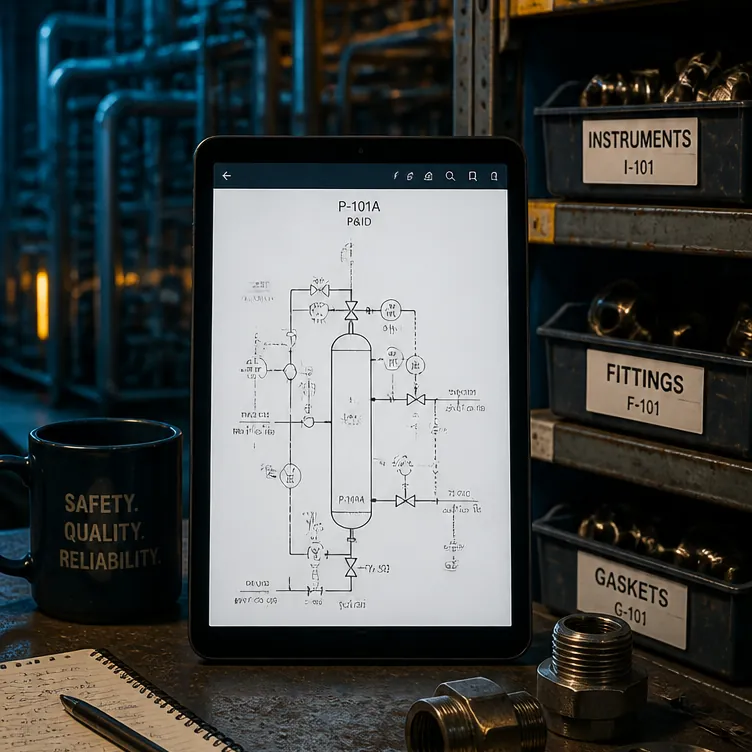
Piping and instrumentation diagrams (P&IDs) and technical drawings can contain rotated content, polygon-shaped text regions, high-resolution images, and unusually long text lines that challenge standard OCR approaches.

#3
Challenge 04

Keep automated results trustworthy

The client needed more than a model prediction. Business rules, confidence scoring, out-of-distribution detection, reconciliation, and QA/QC outputs were incorporated into the processing workflow.

#4

Why generic OCR was not enough

The differentiator wasn't another OCR model. It was the engineering around it.


For millions of technical records, OCR alone could not provide the structured information the client needed. Documents included scanned pages, rotated drawings, inconsistent layouts, and domain-specific terminology.

What the pipeline had to understand

  • Document context: page type, page sequence, title, and document structure
  • Engineering information: equipment tags, AFE numbers, facilities, lines, and other domain entities
  • Result confidence: whether extracted information met the conditions for acceptance

How Azati addressed it

The pipeline combined machine learning with deterministic rules and validation logic. ML handled OCR, classification, entity recognition, and document understanding, while rules and scoring mechanisms helped constrain and verify the results.

In other words: OCR extracted the text; the processing system turned it into controlled engineering data.

Assess your technical document estate

Bring a representative sample of your documents, extraction requirements, and quality constraints. Azati can help determine whether standard OCR is sufficient or whether a custom document intelligence pipeline is justified.

Discuss your document-processing challenge

How Azati contributed

01

Custom GPU OCR for engineering drawings and technical records

Azati built a custom GPU OCR stack for high-resolution technical documents and P&IDs. Polygon-level detection helped handle text in orientations and layouts that conventional bounding-box approaches struggle with.

The pipeline combined:
  • TextBPN++ for polygon-level text detection
  • ParSeq / TrOCR for text recognition
  • ViT for rotation correction
  • Dynamic-programming-based fusion for long lines
  • Tiled inference for very large documents
02

Context-aware page classification

Document classification was implemented with a hierarchical DistilBERT-based model. Rather than treating every page as an isolated input, the model used the history and context of previous pages when classifying documents. This matters when a technical record consists of multiple pages whose meaning depends partly on where they appear in the document.

What the classification actually enabled:
  • Page-type recognition
  • Document-level context
  • Hierarchical classification
  • Context for downstream extraction
03

Domain-specific engineering metadata and entity extraction

The pipeline also needed to extract technical entities rather than simply produce searchable text. Azati developed a custom DistilBERT-based architecture for NER and applied it to information relevant to the client's technical records workflows. The extraction layer was complemented by scoring and out-of-distribution detection using CatBoost.

Technical-record entity extraction:
  • AFE
  • FTN
  • Facility information
  • Line information
  • Country and related metadata
04

From raw PDF to structured business output

Azati connected the individual AI components into a complete processing workflow:

PDF → image conversion → text detection → OCR → rotation correction → page classification → entity extraction → title extraction → QA/QC → reconciliation → structured reports.

The pipeline also produced searchable PDFs with embedded OCR text.

Four structured report types:
  • Document indexes
  • Document metadata
  • FTN metadata
  • Record metadata
05

Distributed technical document processing at scale

At approximately 5 million documents, the pipeline required distributed processing rather than isolated ML workloads. Azati used Ray, KubeRay, Kubernetes, and NVIDIA GPUs with asynchronous batching to coordinate large processing jobs.

The resulting system comprised:
  • 3 OCR microservices
  • 3 ML services
  • 15+ Ray jobs
  • 20+ pipeline steps
  • FoundationDB task tracking
  • ClickHouse reconciliation

Delivery and outcomes

The resulting system combined custom GPU OCR, hierarchical classification, domain-specific extraction, and operational controls into a repeatable distributed processing workflow.

Delivery areaWhat Azati deliveredBusiness impact
Bulk document processingDistributed Ray + Luigi pipeline across 15+ Ray jobs and 20+ processing stepsCreated a repeatable processing workflow for a ~5M-document technical estate
Technical OCRCustom GPU OCR with detection, recognition, rotation handling, tiled inference, and polygon-level processingMade difficult engineering PDFs suitable for downstream classification and extraction
Document classificationHierarchical BERT classification using page-history contextAdded document/page structure to the processing workflow rather than treating pages as isolated images
Metadata extractionDomain-specific NER and extraction for AFE, FTN, facility, line, country, and other technical informationConverted relevant technical-record content into structured data
AI quality controlsOOD detection, scoring, QA/QC generation, deterministic business rules, and reconciliationAdded control mechanisms around probabilistic extraction
PDF processingPage/PDF de-rotation and OCR text embeddingProduced searchable versions of processed technical documents
Structured reportingFour Excel report types covering indexes, document metadata, FTN metadata, and record metadataMade extracted information available in structured operational formats
Data and task managementFoundationDB task tracking and ClickHouse reconciliationSupported coordination and validation across the distributed processing workflow
Production infrastructureKubernetes, KubeRay, NVIDIA CUDA/GPU infrastructure, Docker, GitLab CI, DVCImplemented infrastructure for repeatable distributed document processing

Benchmark your document-processing approach

Not sure whether your current OCR, document AI, or manual workflow can meet the required quality and throughput? Start with document types, extraction targets, validation rules, and a representative sample.

Plan a document AI assessment

Business impact

A 5M-document estate became processable at scale

The architecture provided a repeatable workflow for OCR, classification, extraction, validation, and reporting.

Technical documents became searchable and structured

The pipeline produced searchable PDFs and structured outputs containing document, metadata, FTN, and record information.

AI outputs gained operational controls

Confidence scoring, OOD detection, reconciliation, deterministic rules, and QA/QC provided mechanisms for identifying results requiring additional verification.

Who benefits from a custom technical document intelligence pipeline?

This type of engagement is best suited to large energy, Oil & Gas, utilities, engineering, infrastructure, and industrial organizations with substantial technical-record estates that need to become searchable, structured, and operationally usable.


Typical stakeholders include organizations responsible for engineering information management, asset data modernization, document digitization, or AI initiatives that depend on legacy engineering documentation.


It is particularly relevant when an organization:

  • Has millions of PDFs, drawings, scanned records, or engineering documents
  • Relies on manual processing or inconsistent legacy OCR
  • Needs to extract domain-specific metadata, tags, entities, or document relationships
  • Must process drawings, tables, rotated pages, symbols, or irregular layouts
  • Needs to combine OCR, classification, extraction, validation, and reporting
  • Requires traceability and controls around AI-generated results
  • Wants to process documents through distributed infrastructure rather than isolated machines
  • Needs extracted information to support technical records, asset information, maintenance, engineering, or compliance workflows

When a custom pipeline makes sense

A custom document intelligence pipeline becomes appropriate when standard OCR can recognize text but cannot reliably produce the structured, validated information the business needs.

Standard OCR vs custom engineering

Standard OCR may be sufficient when the requirement is searchable text from clean, consistent documents. Custom engineering becomes more relevant when the documents contain drawings, irregular layouts, domain-specific entities, multiple page types, or strict validation requirements.

Beyond searchable text

For example, an organization may need to know not only what text appears in a document, but whether a page belongs to a particular record, which technical entity it references, what metadata should be associated with it, whether the extracted result is sufficiently reliable, and how that information should enter downstream workflows.

Frequently asked questions

Oil & Gas companies can automate technical document processing by combining OCR, classification, metadata extraction, validation, and structured reporting in one workflow. The practical challenge is that technical records often require domain-specific rules and context rather than text recognition alone. In this engagement, Azati combined custom OCR, hierarchical document classification, domain-specific entity extraction, business rules, QA/QC, and distributed processing to process a technical document estate of approximately 5 million documents.

AI can extract metadata from technical documents when models are trained or configured for the document structures and entities relevant to the business. In practice, reliable metadata extraction usually requires a combination of machine learning, document context, deterministic rules, and validation rather than a generic language model alone. Azati implemented domain-specific extraction for information including AFE, FTN, facility, line, and country data, together with OOD detection, scoring, QA/QC, and reconciliation.

Technical document OCR has to handle factors such as drawings, rotated pages, complex layouts, technical terminology, and very large documents that can make conventional OCR insufficient. The practical implication is that OCR may need to be combined with layout-aware detection, rotation handling, tiled inference, and domain-specific downstream processing. Azati developed custom GPU OCR using text detection, recognition, rotation detection, polygon-level processing, and tiled inference for the client's technical records.

AI can classify document pages individually, but page-level classification can become more reliable when the model also considers document context. The practical implication is that sequential technical records may require page-history or surrounding-page information rather than independent classification of every page. Azati implemented hierarchical BERT-based page classification incorporating page-history context.

AI-extracted information can be validated by combining model confidence, out-of-distribution detection, deterministic business rules, reconciliation, and human or operational QA/QC where required. The practical implication is that probabilistic extraction should be surrounded by controls rather than treated as automatically correct. In this engagement, Azati combined CatBoost-based OOD detection and scoring with business rules, QA/QC generation, ClickHouse reconciliation, and structured reporting.

A custom pipeline becomes relevant when document volume, document complexity, domain-specific extraction requirements, or quality requirements exceed what a standard OCR product can reliably provide. The practical implication is that the decision should be based on the required business output, not simply on the number of documents. In this engagement, a previous approach had not achieved the required extraction quality, leading to a custom architecture combining GPU OCR, domain-specific ML, business rules, distributed processing, and QA/QC.

Document digitization generally focuses on converting physical or scanned information into a machine-readable representation, while document intelligence adds classification, extraction, contextual interpretation, validation, and structured outputs. The practical implication is that companies looking to use technical records operationally usually need more than searchable text. Azati's engagement went beyond OCR to classify pages, extract domain-specific entities and metadata, generate structured Excel reports, reconcile results, and produce searchable PDFs.

Cost depends on document volume, document types, scan quality, extraction requirements, validation thresholds, infrastructure, downstream integrations, and the degree of human review required. A proof of concept may use a limited document sample, while millions of technical records require distributed processing, model optimization, orchestration, storage, and operational controls.

Yes. A document intelligence pipeline can produce searchable PDFs, structured files, APIs, database records, or other outputs required by downstream engineering, asset, records-management, or reporting systems. Integration requirements should be defined alongside extraction requirements.

Azati's related expertise in industrial document intelligence

Explore the relevant projects and see how Azati delivers measurable results for the clients.

AI-Powered Engineering Document Verification and Data Quality Automation
Oil & Gas

AI-Powered Engineering Document Verification and Data Quality Automation

~100,000 engineering documents processed in production
50-70% estimated reduction in manual engineering document review
40-60% less time spent preparing engineering reporting data
  • Python
  • Computer Vision
  • FastAPI
  • PostgreSQL
  • Oracle Cloud Infrastructure
  • Engineering document AI

Business challenge

A major Middle Eastern oil and gas operator struggled with manually reviewing and reconciling massive volumes of engineering documents, leading to operational delays and errors. The client required a scalable, automated verification solution that integrated seamlessly with their existing engineering workflows.

Solution at a glance

Azati developed an AI-powered platform that automates the extraction and validation of technical documents and AutoCAD drawings, seamlessly integrating with the client's Knowledge Hub to streamline reviews without disrupting existing workflows.

How Azati solved the challenge

  • Intelligent engineering document processing: Built AI models capable of extracting structured engineering information from technical documents, engineering drawings, and AutoCAD files while accurately interpreting engineering notation, layouts, and technical relationships.
  • Automated engineering data verification: Replaced manual cross-checking by automatically validating extracted engineering information against existing enterprise records and highlighting inconsistencies requiring expert review.
  • AI-assisted engineering interpretation: Applied advanced AI techniques to interpret complex engineering documentation across varying contractor formats, improving extraction quality while adapting to evolving document types and engineering conventions.
  • Seamless platform integration: Integrated validated engineering data directly into the client's existing Knowledge Hub, allowing engineers to continue working within established processes without adopting additional software.
  • Continuous operational improvement: Designed an iterative processing pipeline that continuously expanded support for new engineering document types, refined extraction models, and accommodated evolving business requirements throughout the engagement.

Business outcome

  • Engineering verification at production scale: Processed approximately 100,000 engineering documents in production, demonstrating the ability to automate engineering documentation well beyond pilot environments.
  • Reduced engineering workload: Estimated manual engineering document review effort decreased by 50-70%, allowing specialists to focus on validating exceptions rather than manually reviewing every document.
  • Faster engineering reporting: Reduced engineering data preparation time for reporting by an estimated 40-60%, accelerating operational reporting and engineering decision-making.
  • Higher engineering data quality: Improved consistency and traceability by automatically validating engineering information against enterprise systems before it reached engineering teams.
  • Scalable engineering operations: Established an AI-enabled engineering document verification process capable of supporting increasing documentation volumes without requiring proportional growth in engineering resources, providing a foundation for future engineering automation initiatives.
AI-Powered Engineering Drawing Digitization and DEXPI Conversion
Oil & Gas

AI-Powered Engineering Drawing Digitization and DEXPI Conversion

35,000 engineering drawings transformed into searchable engineering data
60-80% estimated reduction in manual engineering effort
DEXPI industry-standard engineering data ready for enterprise integration
  • Python
  • Computer Vision
  • OpenCV
  • FastAPI
  • Oracle Cloud Infrastructure
  • Engineering document AI

Business challenge

An oil and gas operator struggled to utilize 35,000 static engineering drawings (PEFS) due to fragmented file formats (AutoCAD, PDF, TIFF), which hindered searchability, process tracing, and system integration. Manual reviews caused significant operational delays, creating a need for a scalable, automated solution to convert these documents into structured, machine-readable data while preserving engineering relationships and industry standards.

Solution at a glance

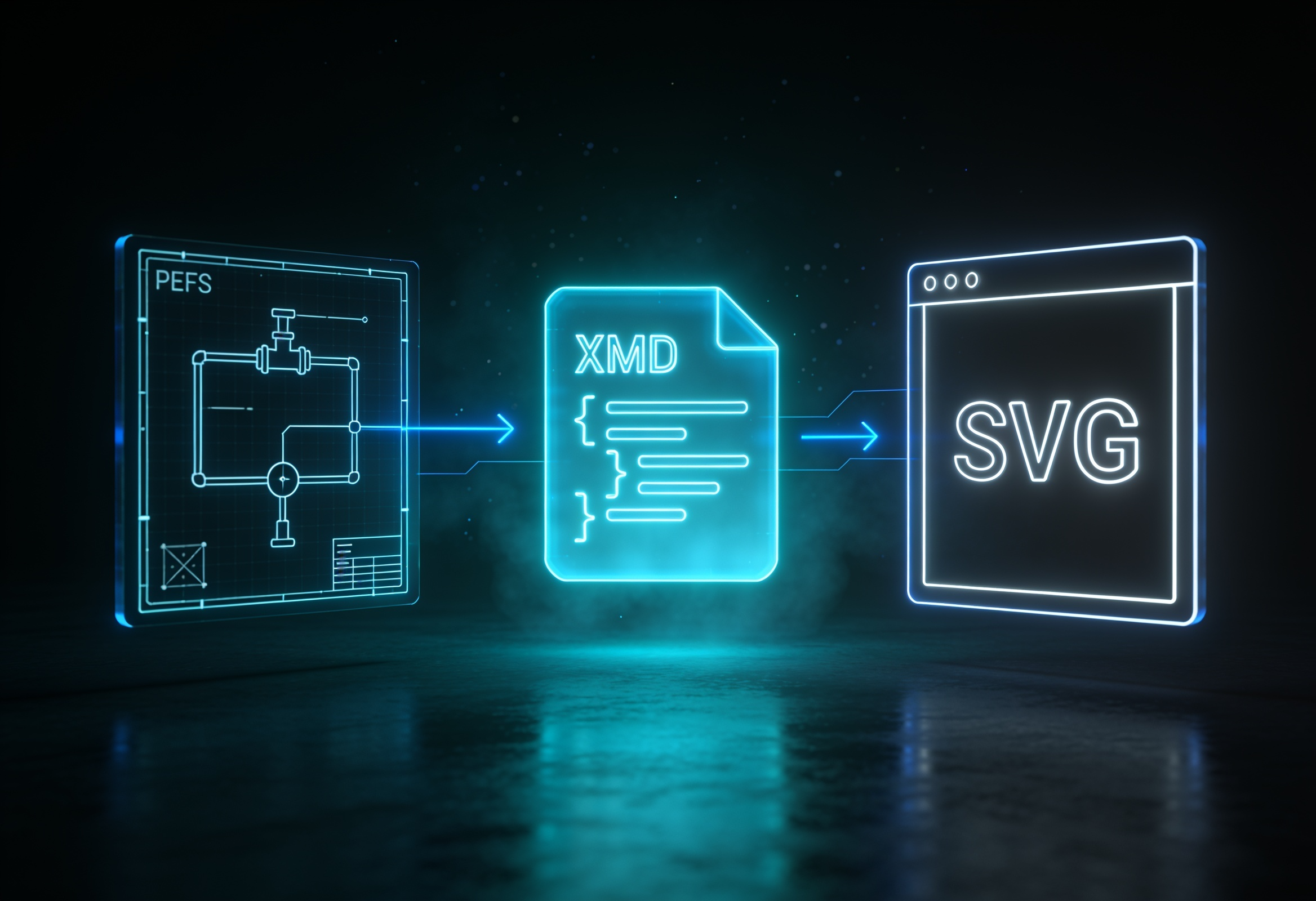
Azati’s AI-powered platform automates PEFS drawing processing, converts data to the DEXPI standard, and validates results for system integration. This transforms static archives into a searchable knowledge base that improves decision-making, streamlines workflows, and supports future digital twin initiatives.

How Azati solved the challenge

  • Multi-format engineering document processing: Developed an AI pipeline capable of processing engineering drawings from AutoCAD, PDF, TIFF, and JPEG formats, creating a unified workflow regardless of the original document source.
  • Engineering data extraction: Applied computer vision and OCR to identify equipment, instruments, engineering tags, and process elements while automatically associating textual information with corresponding engineering objects.
  • Process topology reconstruction: Built intelligent algorithms that reconstruct relationships between engineering components, transforming disconnected drawing elements into structured representations of process networks rather than simple collections of extracted symbols.
  • DEXPI-standard conversion: Converted engineering data into DEXPI-compliant models with automated validation, enabling direct integration with engineering platforms, asset management systems, and future digital engineering initiatives.
  • Continuous quality improvement: Implemented an iterative review and model refinement process that continuously improves extraction accuracy as additional engineering drawing types and conventions are processed.

Business outcome

  • Searchable engineering knowledge: Converted approximately 35,000 engineering drawings into structured engineering information, enabling engineers to locate equipment, process relationships, and engineering assets without manually reviewing thousands of documents.
  • Reduced engineering workload: Pilot results demonstrated an estimated 60-80% reduction in manual engineering effort by automating extraction, classification, topology reconstruction, and standards-based conversion.
  • Higher engineering data quality: Delivered validated engineering information in an industry-standard format, improving consistency, traceability, and confidence in engineering documentation.
  • Integration-ready engineering data: Produced DEXPI-compliant outputs that can be consumed directly by engineering platforms, enterprise asset management systems, and other downstream applications without requiring extensive custom transformation.
  • Foundation for digital engineering: Established the structured engineering data layer required to support future initiatives such as digital twins, predictive maintenance, engineering analytics, and intelligent asset management.
Automated Tag Extraction and AVEVA Table Generation from Engineering Drawings
Energy, Oil & Gas

Automated Tag Extraction and AVEVA Table Generation from Engineering Drawings

300 engineering documents processed per hour
3 months from data annotation to production MLOps pipeline
Multi-level tag classification based on visual drawing context
  • Python
  • PyTorch
  • OpenCV
  • FastAPI
  • AWS
  • Docker

Business challenge

A large oil and gas operator needed to extract and classify tag data from engineering drawings and identify equipment connections from wiring diagrams. Manual processing required substantial engineering effort, while tag meaning could vary by drawing type and connection data was encoded in drawing geometry rather than text.

Solution at a glance

Azati built an end-to-end computer vision pipeline that extracts text and symbols, classifies tags using visual context, reconstructs equipment connections from wiring diagrams, and generates structured AVEVA Engineering tables for engineer review. The production pipeline was delivered in three months and processes up to 300 documents per hour.

How Azati solved the challenge

  • Engineering drawing text and symbol extraction: Combined OCR and PDF processing with computer vision models to identify text, equipment symbols, and tags across engineering document types.
  • Context-based tag classification: Classified tags using the drawing type, surrounding symbols, layout, and cross-document context rather than relying on fixed tag-to-category mappings. This allowed the same tag to be interpreted differently when its meaning depended on the document context.
  • Equipment connection detection: Analyzed the spatial geometry of wiring diagrams to trace wires between equipment symbols and reconstruct connection information that could not be obtained through text extraction alone.
  • AVEVA Engineering table generation: Combined classified tags, attributes, and connection data into structured AVEVA Engineering table formats, giving engineers a prepared output for review and correction.
  • Parallel ML development and annotation: Ran data annotation, model development, infrastructure setup, and integration in parallel. CVAT supported annotation, while DVC and Weights & Biases provided dataset and experiment tracking throughout development.
  • Production MLOps pipeline: Deployed the extraction and classification services with FastAPI and Docker on AWS, creating a production pipeline capable of processing up to 300 engineering documents per hour.

Business outcome

  • 300 documents processed per hour: The automated pipeline processes up to 300 engineering documents per hour, substantially increasing the volume of drawing data that can be handled compared with manual extraction.
  • Engineering effort shifted to review: Engineers receive structured extraction results for review and correction instead of performing the initial tag-by-tag extraction manually.
  • More consistent drawing-data classification: Visual-context classification addresses cases where tag meaning depends on drawing type and surrounding engineering information, reducing reliance on rigid templates.
  • Automated connection data extraction: The pipeline reconstructs equipment connections from wiring-diagram geometry and incorporates the results into structured engineering output.
  • Production-ready foundation for engineering document AI: The project established a reusable MLOps foundation spanning annotation, dataset versioning, experiment tracking, model serving, containerization, and cloud deployment.
AI-Assisted Engineering Data Extraction and Legacy Drawings Digitization
Energy, Oil & Gas

AI-Assisted Engineering Drawings Digitization

471 engineering drawings processed
2x faster engineering review and FMR preparation
45% reduction in manual interpretation workload
  • OCR
  • Python
  • YOLO11 / Ultralytics
  • Qwen3.5-VL
  • Transformer
  • Amazon S3

Business challenge

A large industrial operator needed to extract flange and engineering data from low-quality legacy P&IDs and piping isometrics to prepare Flange Master Registers (FMR). Degraded scans, inconsistent layouts, handwritten annotations, and ambiguous graphical elements made conventional OCR and fully autonomous AI unreliable.

Solution at a glance

Azati built a hybrid engineering document intelligence workflow combining computer vision, multimodal AI, deterministic validation, and human engineering QA. The solution identified flange joints, interpreted engineering annotations, structured the extracted data, and prepared validated FMR outputs while keeping engineers in control of ambiguous cases.

How Azati solved the challenge

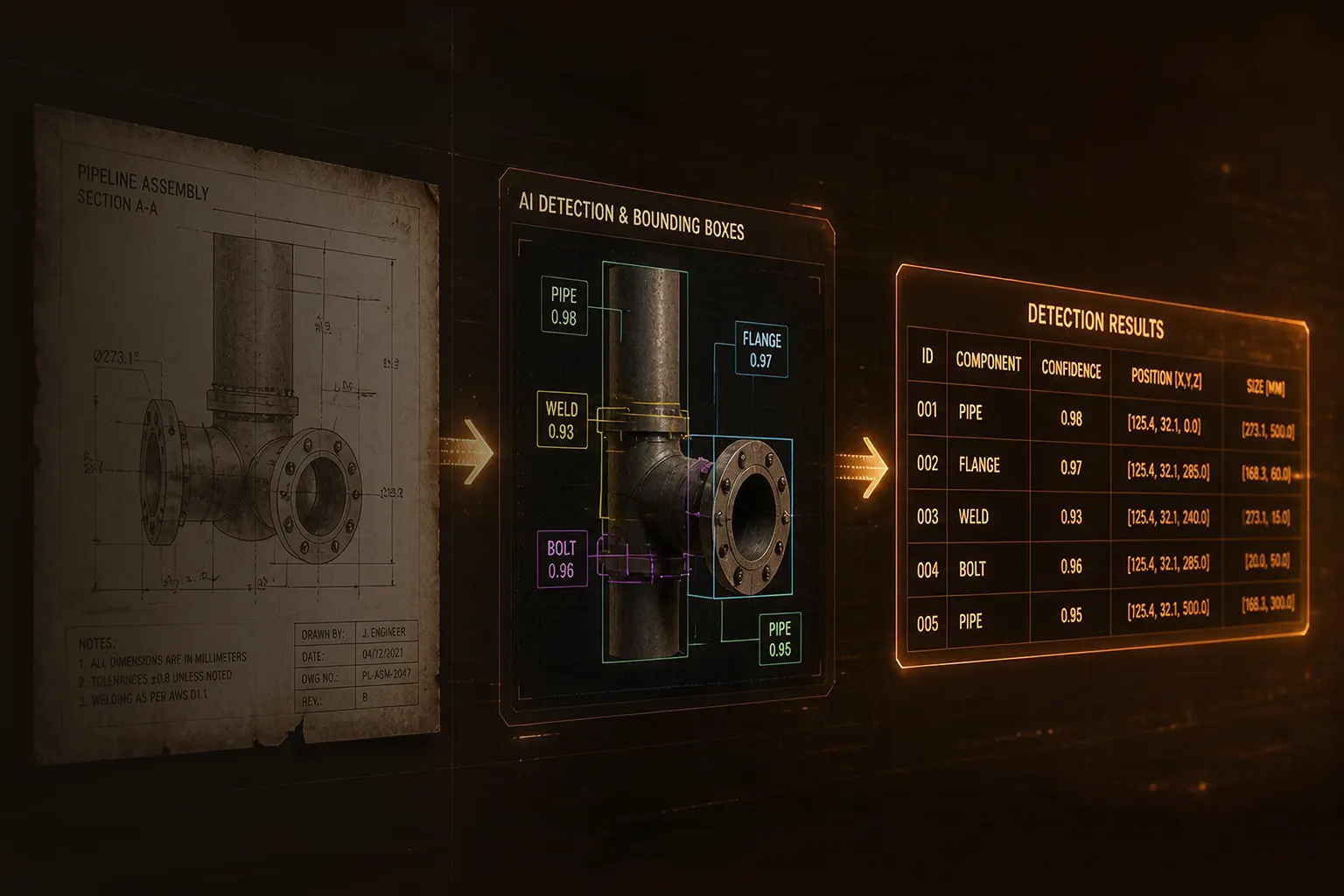
  • AI-powered flange identification: Used object detection to identify flange joints across archived piping drawings, assign unique IDs, and generate engineering markups, including for low-quality scans.
  • Multimodal engineering document understanding: Combined OCR and multimodal AI to interpret engineering annotations, tables, and contextual information within drawings and convert the results into structured data.
  • Context-aware data extraction: Analyzed drawing regions and engineering context rather than relying on text extraction alone, enabling the workflow to handle fragmented layouts and non-standard documentation.
  • Deterministic validation and normalization: Applied rules-based validation to detect inconsistent outputs, filter noise and hallucinations, normalize extracted information, and maintain data consistency.
  • Human engineering QA: Designed a human-in-the-loop workflow in which engineers review and correct ambiguous cases instead of manually processing every drawing from scratch.
  • Flange Master Register preparation: Combined validated flange identification and engineering metadata into structured outputs suitable for FMR preparation and downstream maintenance, procurement, and asset-integrity workflows.

Business outcome

  • 2x faster engineering review: AI-assisted extraction and validation accelerated flange identification and FMR preparation, reducing the time required for engineering review.
  • 45% less manual interpretation: The hybrid workflow automated repetitive document analysis while allowing engineers to focus on exceptions and engineering validation.
  • 471 drawings processed: The solution demonstrated automated processing of 471 engineering drawing pages while maintaining a controlled validation workflow.
  • Better maintenance readiness: Structured and validated engineering information reduced documentation bottlenecks for maintenance and shutdown planning.
  • Reusable foundation for engineering document modernization: The project established a practical workflow for applying AI to additional legacy engineering documentation and future engineering data modernization initiatives.
Embedded AI Search for Oil and Gas Engineering Reviews
Energy, Oil & Gas Engineering & Manufacturing

Embedded AI Search for Oil & Gas Engineering Reviews

~92% faster search for similar engineering observations
85–90% similarity-matching quality in feature testing
50,000+ historical observations made searchable
  • GraphQL
  • PostgreSQL
  • Hasura
  • Java
  • JavaScript
  • Python
  • Spring Boot
  • React

Business challenge

Engineering teams accumulated valuable knowledge across capital projects, but finding comparable historical observations required manual searches through project records, reviews, and documentation. The client needed faster knowledge retrieval without introducing a separate tool or disrupting established engineering workflows.

Solution at a glance

Azati embedded AI-powered semantic search directly into the client's existing capital project platform. The solution combines domain-restricted retrieval, LLM orchestration, contextual recommendations, and enterprise controls to help experts find relevant historical observations within their normal review workflow.

How Azati solved the challenge

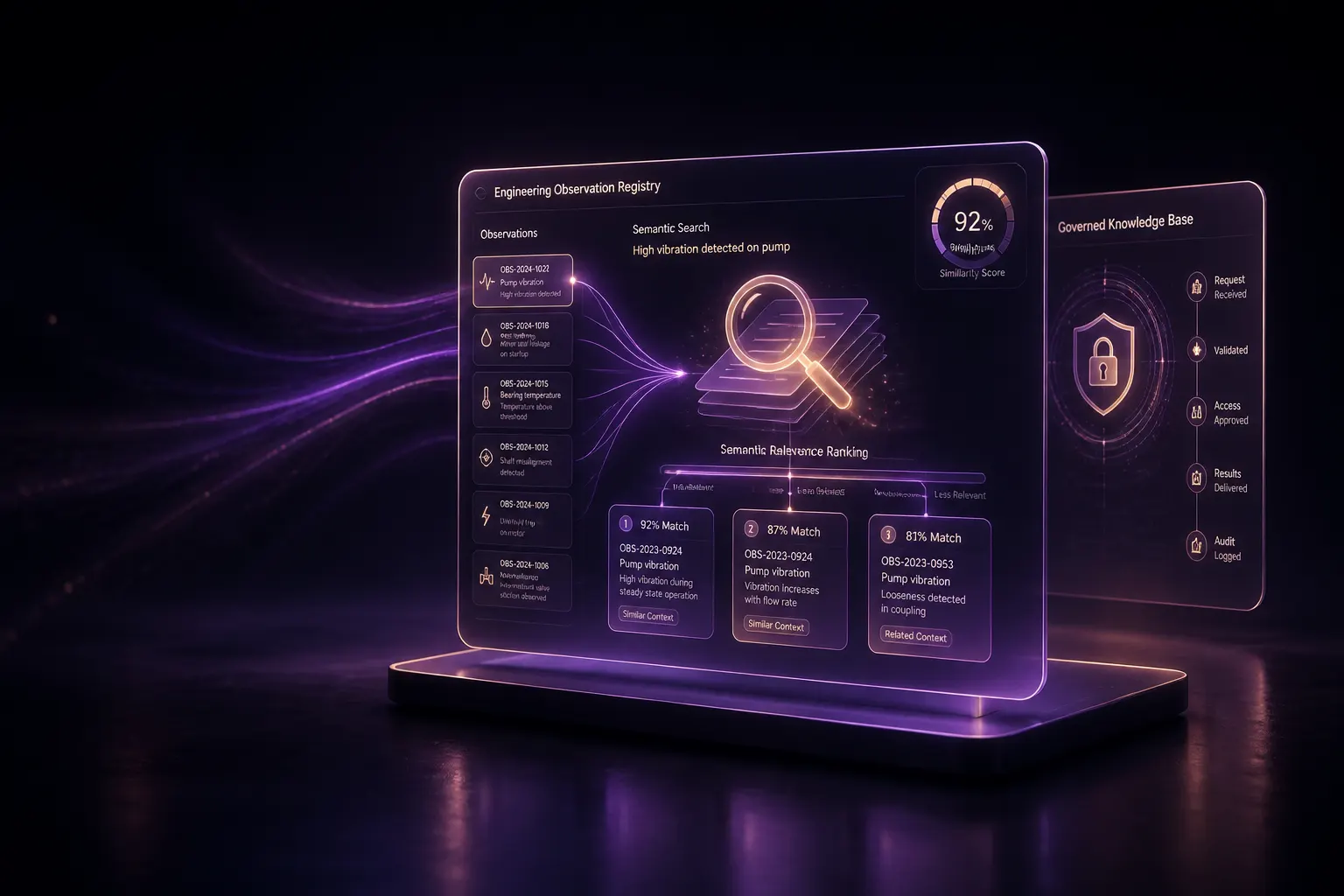
  • AI-assisted engineering search: Implemented semantic retrieval that identifies and ranks similar historical observations within the relevant engineering discipline, with links back to their source projects, phases, and remediation history.
  • Embedded AI workflow integration: Integrated AI search directly into the engineering registry so experts can launch searches from an observation and review recommendations without leaving the existing platform.
  • Enterprise AI orchestration: Introduced a dedicated orchestration layer for LLM requests, response persistence, lifecycle management, timeouts, and controlled execution rather than relying on unmanaged direct LLM calls.
  • Contextual decision support: Presented ranked observations together with the context experts need to assess relevance, including similarity score, project stage, engineering phase, priority, remediation status, and responsible engineer.
  • Controlled enterprise retrieval: Restricted AI-assisted retrieval to the appropriate engineering domain and integrated request tracking and workload controls to support governed use within the existing enterprise environment.

Business outcome

  • ~1 hour to up to 5 minutes: AI-assisted search reduced the time required to locate comparable engineering observations by approximately 92%, accelerating review and reducing repetitive project navigation.
  • 50,000+ observations searchable: Historical engineering knowledge that was previously distributed across projects became accessible through a unified AI-assisted search experience, supporting knowledge reuse across the organization.
  • Faster engineering review: Ranked recommendations and contextual project information helped experts spend less time locating relevant precedents and more time evaluating engineering decisions.
  • AI without workflow disruption: AI was embedded into the existing engineering interface rather than introduced as a separate application. The capability was delivered in four weeks with no reviewer retraining required.
  • Governed enterprise AI foundation: Centralized orchestration, request tracking, response persistence, timeout handling, retention controls, and domain-restricted retrieval established a controlled foundation for future AI-assisted engineering workflows.

Last updated

Got a job for Azati? Let’s talk business!

This site is protected by reCAPTCHA and the Google Privacy Policy and Terms of Service apply.

What's next?

  • 1. Tell Us Your Story
    Describe your project. We come back within 24 hours with team availability and a rough plan. NDA on request before the first call.
  • 2. Get Your Roadmap
    Receive a detailed proposal with scope, team composition, timeline, and costs tailored to your goals.
  • 3. Start Building
    Azati aligns on details, finalize terms, and launch your project with full transparency.