Experience supporting massive analytical ecosystems
The engagement involved hundreds of flows, thousands of analytical structures, and continuously evolving reporting requirements across multiple systems.
How to improve access to trusted business data across multiple enterprise systems?
Azati helped a large chemical enterprise modernize and continuously evolve its analytical platform by developing data pipelines, analytical data marts, and orchestration workflows. The engagement strengthened access to trusted business data, improved operational visibility, and established scalable foundations for future analytics initiatives.
of analytical data marts and pipelines built and enhanced
of flows within the enterprise data ecosystem
of analytical structures and relationships supported


Large industrial organizations often operate dozens of business systems and generate continuously growing volumes of operational data. To support reporting, analytics, and decision-making, they require scalable mechanisms to collect, transform, and deliver trusted information to downstream systems.
The client operated a large platform that played an important role in enterprise information management by consolidating data from multiple systems and providing trusted analytical assets for reporting and decision-making.
Azati joined the engagement as part of an extended delivery team and contributed to the ongoing development of data pipelines, analytical data marts, and optimization of data processing mechanisms.
As new business initiatives and systems emerged, the organization continuously required new data pipelines and analytical structures capable of supplying reporting and downstream analytics.
The environment included numerous systems, hundreds of data flows, and extensive interdependencies. Maintaining consistency while expanding the platform required careful coordination and scalable approaches to data engineering.
Business teams depended on reliable information extracted from multiple sources. Data preparation processes had to ensure that analytical consumers could access consistent, trustworthy datasets capable of supporting reporting and operational decision-making.
Growing volumes of information and increasingly complex transformations required continuous improvements to data processing logic and optimization of existing workflows.
The engagement involved hundreds of flows, thousands of analytical structures, and continuously evolving reporting requirements across multiple systems.
Azati specialists integrated into established architectures and processes while providing additional engineering capacity.
Rather than isolated initiatives, the Azati team contributed to an environment where new systems and reporting requirements emerged continuously.
Enterprise analytical platforms depend on numerous systems and constantly changing business requirements. Azati supported the evolution of a complex ecosystem while maintaining continuity across interconnected workflows and enabling the gradual expansion of analytical capabilities.
Azati helps organizations improve analytical platforms, develop data pipelines, and provide trusted information for reporting and operational decision-making.
Discuss your data platformAzati developed analytical pipelines, data marts, and orchestration mechanisms using SQL, Python, dbt, Apache Airflow, Apache NiFi, Greenplum, PostgreSQL, and ClickHouse. The resulting platform delivered trusted datasets that supported reporting and self-service analytics across multiple business domains.
Azati contributed to the continuous evolution of a large-scale data platform responsible for integrating information from multiple systems and delivering datasets used by downstream reporting and self-service analytics. The improvements strengthened the reliability and consistency of analytical workflows that support reporting and operational analysis.
The platform continuously collected information from multiple enterprise systems. Azati supported the development of mechanisms responsible for bringing data into the analytical environment and preparing it for downstream processing.
Working together with architects and delivery teams, Azati contributed to analytical models and internal structures supporting the storage and organization of information used across reporting processes.
The engagement focused on developing business-oriented analytical data products that simplified access to information required by reporting and analytics teams. Instead of requiring users to work directly with complex enterprise datasets, the platform provided curated analytical structures optimized for downstream reporting and self-service analytics.
The platform relied on orchestration mechanisms that enabled continuous processing and delivery of information across multiple systems.
As analytical requirements expanded, existing transformations and loading mechanisms required ongoing improvements. Azati contributed to optimization initiatives that enhanced efficiency and maintainability across data workflows.
The engagement supported architectural approaches designed to accommodate growing analytical requirements and ensure the scalability of enterprise analytics initiatives.
| Area | Azati contribution |
|---|---|
| Data engineering | Developed and maintained analytical pipelines |
| Data modeling | Contributed to structures supporting new systems |
| Data marts | Built reporting-oriented analytical datasets |
| Workflow automation | Supported orchestration and processing mechanisms |
| Performance | Improved SQL logic and optimized transformations |
| Platform evolution | Enhanced existing loading scripts and workflows |
| Reporting support | Supplied trusted datasets for BI teams |
| Delivery | Worked within a long-term Scrumban process |
Azati worked inside a highly interconnected environment consisting of hundreds of flows and thousands of analytical structures. The engagement required balancing evolving business requirements with performance optimization and platform stability.
The environment involved hundreds of data flows, thousands of tables, and extensive dependencies between systems. Supporting platform evolution required understanding complex relationships and maintaining consistency across the analytical ecosystem.
New systems and reporting needs regularly appeared, requiring the platform to accommodate changing business priorities.
As analytical assets expanded, transformations and loading processes required ongoing refinement to maintain efficiency.
Enhancements had to integrate with existing structures while preserving platform stability and continuity.
Azati helps organizations modernize analytical infrastructures, develop data pipelines, and support reporting ecosystems that depend on trusted information.
Talk to a data engineering expert| Metric | Value |
|---|---|
| Engagement duration | 24+ months |
| Delivery model | Ongoing |
| Data marts and pipelines developed | Dozens |
| Data ecosystem complexity | Hundreds of flows and thousands of tables |
| Collaboration model | Embedded delivery |
Azati’s improvements to data processing mechanisms helped the client strengthen the reliability and consistency of analytical workflows through continuous enhancement of pipelines and analytical structures.
Curated analytical datasets simplified information consumption for BI teams and supported self-service analytics without requiring direct interaction with complex source systems.
Reliable analytical structures improved operational analytics capabilities and enabled business stakeholders to access information required for monitoring and decision-making across multiple domains.
Continuous enhancements helped accommodate changing reporting requirements and new systems.
Optimization efforts and scalable architectures improved maintainability of enterprise data workflows. Business-oriented analytical structures helped enable reporting and self-service analytics initiatives.
Azati integrated into the client's established environment and contributed to long-term analytical platform development.
Curated analytical datasets enabled reporting and BI teams to access consistent information without interacting directly with the complexity of underlying systems, strengthening trust in analytical processes.
Reliable analytical structures improved access to information used for reporting and operational analysis across multiple business domains.
Continuous optimization and scalable architectural approaches established a stronger foundation for accommodating new systems and changing reporting requirements.
Azati integrated into the client's established delivery organization and contributed to the ongoing development of analytical infrastructure without disrupting existing processes.
Business-oriented analytical data products simplified information consumption, supporting self-service analytics initiatives and reporting teams in accessing curated datasets tailored to their needs.
Azati participated as part of a broader engineering organization supporting enterprise data initiatives.
The engagement followed a Scrumban approach with evolving requirements and ongoing delivery activities.
Azati provided a dedicated data engineering specialist responsible for analytical pipelines, data marts, and optimization activities.
Explore our successful projects and see how Azati delivers measurable results for our clients.

The client needed to optimize document generation and management workflows across internal enterprise systems. Their existing processes relied on fragmented integrations between SAP ERP and a document generation platform, causing delays, manual overhead, inconsistent data exchange, and frequent processing errors. The client required a middleware integration layer capable of securely orchestrating enterprise document workflows while supporting different protocols, formats, and business logic requirements.
Azati developed a middleware data bus integrating SAP ERP with the client’s document generation system. Using Apache Camel, Spring, and SOAP web services, the solution automated enterprise document workflows and enabled reliable real-time data exchange between systems. The platform standardized message processing, automated document-related operations, transformed and enriched incoming data, improved validation and error handling, and ensured secure communication between systems.

The client needed to process large volumes of unstructured industrial data (documents, schemes, technical records), but faced low accuracy of manual data extraction, time-consuming processing workflows, inconsistent data formats, and difficulty integrating extracted data into operational systems. These issues slowed down decision-making and increased operational costs.
Azati developed an AI-powered data recognition system to automate the extraction, structuring, and validation of industrial data. The solution focused on: applying machine learning and computer vision for data extraction, structuring unstructured data into usable formats, integrating outputs into existing workflows and systems, continuously improving accuracy through validation and feedback loops. This enabled faster and more reliable data processing at scale.

The client, an insurance company with a self-service web platform, faced complex workflow inconsistencies, data integrity risks, and limited QA coverage, which affected customer experience and operational efficiency. Multi-step processes like policy management and customer interactions were prone to errors, slowing down releases and increasing support overhead. Our task was to provide full-cycle quality assurance to stabilize the platform, ensure workflow accuracy, and improve release reliability.
Azati's QA team worked closely with the client to analyze insurance-specific workflows such as policy management, customer self-service actions, and backend integrations. We combined manual and automated testing, focusing on validating business logic, ensuring data consistency across systems, and covering real-world user scenarios. Special attention was given to multi-step workflows, integrations with backend systems (CRM, billing, databases), and edge cases that could impact compliance and customer trust.

A large insurance organization struggled with fragmented customer information distributed across multiple departments and disconnected applications. Sales, marketing, customer support, and operational teams relied on separate systems that stored overlapping and often inconsistent customer records.
As the business expanded, manual data consolidation became increasingly time-consuming and error-prone. Teams lacked a unified customer view, reporting required significant manual effort, and business processes varied across departments. The organization needed a centralized platform capable of improving customer engagement while establishing consistent and trustworthy master data across the enterprise.
Azati implemented an integrated CRM and Master Data Management (MDM) platform that consolidated customer, policy, and product information into a single source of truth. The solution automated data synchronization, standardized business processes, enabled real-time performance monitoring, and replaced multiple disconnected legacy systems.
The platform improved operational efficiency, increased reporting capacity, reduced software costs, and provided a scalable foundation for future business growth.
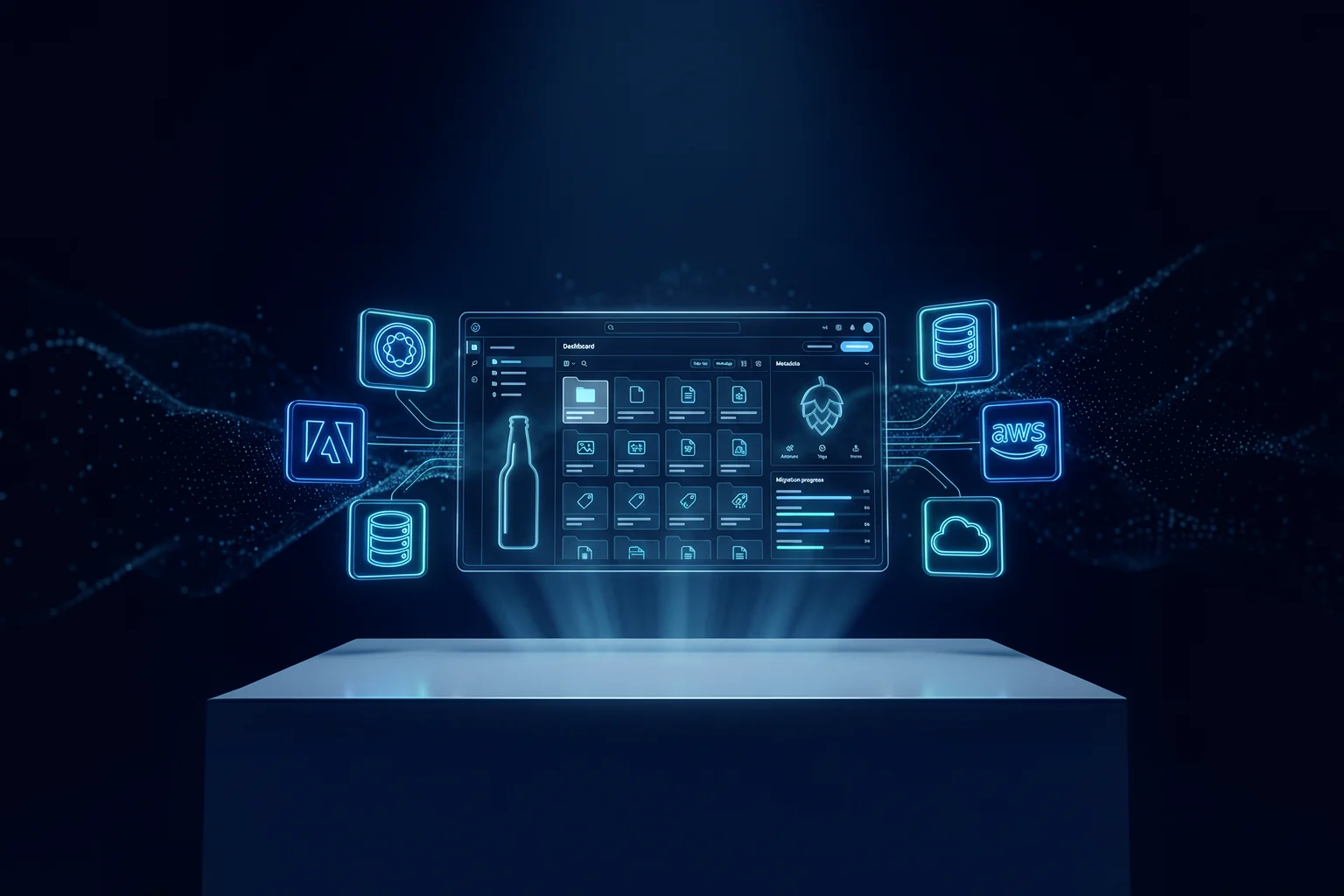
A global beverage enterprise relied on an Adobe AEM-based digital asset management platform supporting marketing operations across multiple regional markets. However, the company lacked internal engineering capacity to manage platform customizations, resolve support issues, and coordinate vendor escalations.
As the organization prepared to transition to a new DAM solution, the migration introduced additional complexity. Asset metadata was inconsistent, APIs contained gaps and inaccuracies, and the migration needed to preserve regional governance rules and access policies without disrupting ongoing operations. The client required a scalable approach that could support future market rollouts rather than a one-time migration effort.
Azati became the client's dedicated technical partner for Adobe AEM operations and later designed a reusable migration framework for transferring digital assets and metadata to a new platform. The engagement combined ongoing platform support, workflow customization, metadata management, and automated migration capabilities.
The approach prioritized business continuity, data integrity, and long-term scalability, allowing the client to maintain uninterrupted marketing operations while building a foundation for future migrations across additional markets.

A petrochemical manufacturer’s Equipment Downtime and Utilization Dashboard became slower as operational transaction volumes grew. The SAP-to-PostgreSQL data pipeline recalculated the entire reporting dataset on every refresh, including static historical maintenance records. The resulting compute overhead affected dashboard responsiveness during peak shift changes, even though the underlying data platform remained fit for purpose.
Azati optimized the existing Apache Airflow pipeline by introducing selective recomputation in PostgreSQL. The solution separated stable historical maintenance data from changing operational parameters, so only modified records required recalculation. This improved dashboard response times without rebuilding the data warehouse, changing the target schema, or disrupting daily reporting.
Last updated