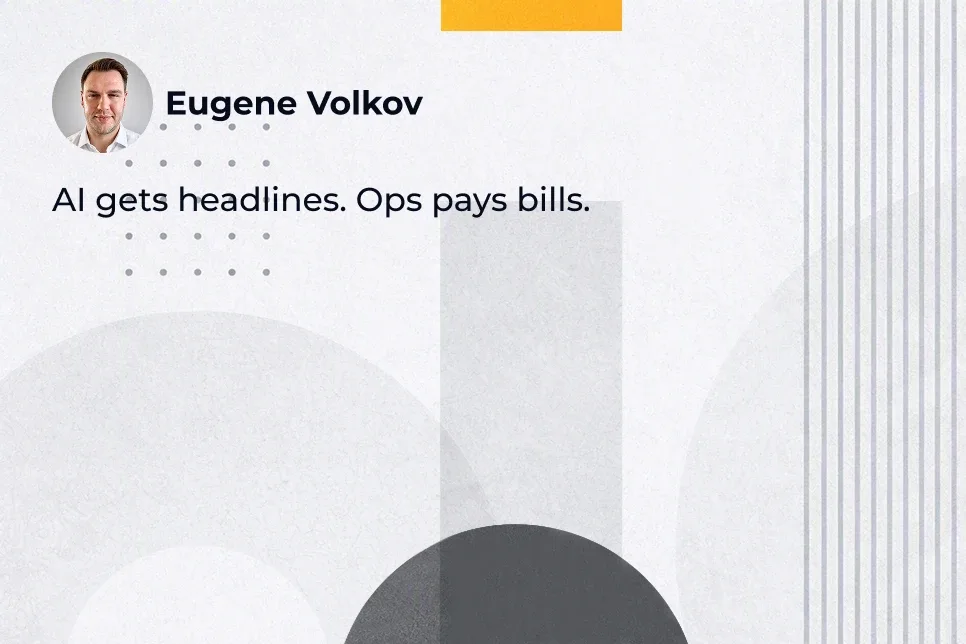

Quick answer: The interesting question was never "can AI do this?" It's "can we make it work repeatedly, safely, and at the scale the business actually needs?" That gap is where most agentic-AI ambitions quietly stall. On an 8+ year media data engagement with 300+ ETL processes, the lesson was blunt: you don't get operational intelligence by bolting something clever onto a messy foundation. The data flows, historical context, applications, and engineering practices underneath have to keep working too. AI gets the headlines. Operationalization pays the bills.
The shallow lesson: "add AI"
As if intelligence were a feature you switch on. It needs saying in 2026, apparently: AI is not a magic wand.
The real lesson: AI is the last layer, not the first
A model only compounds value on top of disciplined data engineering. A polished demo is a proof that something is possible; a production system is a promise that it will keep happening on a Tuesday when a source schema changes and nobody's watching.
The sobering part
An impressive demo and a system the business can rely on are different artifacts built on different timelines. One is a week of cleverness. The other is years of unglamorous foundation work that no keynote will ever celebrate.
Full disclosure
This foundation-then-AI work is exactly what Azati does — that 300+ ETL media platform is ours — so we're biased toward "operationalization first." See our engineering work.
FAQ
Adapted from a LinkedIn post by Eugene Volkov, Commercial Director at Azati Software – read the original, written around Data Expo 2026 in Utrecht (and Tjerrie Smit's keynote on operationalizing agentic AI at NN Group).