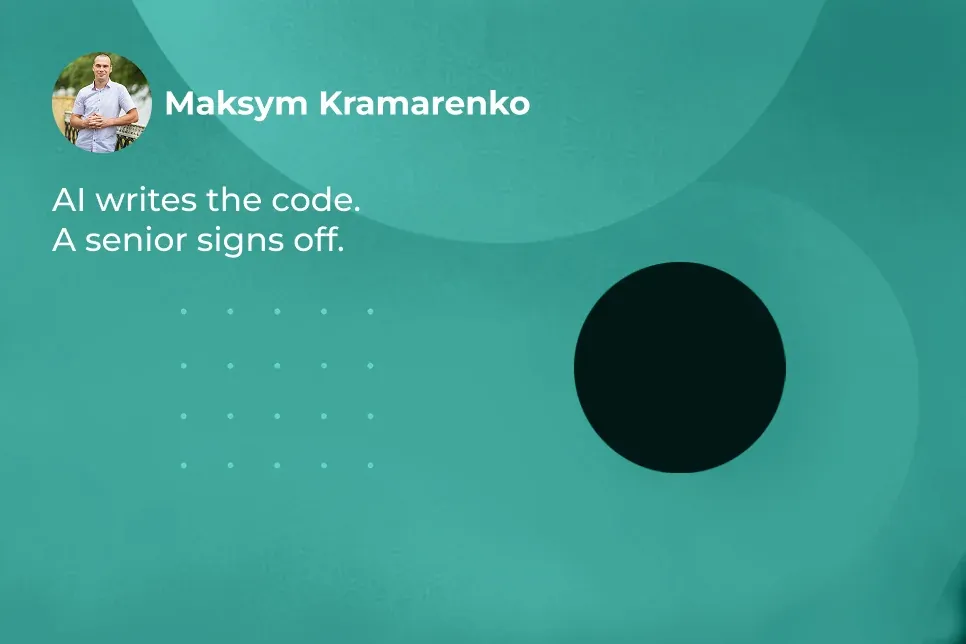

Quick answer: The loudest brag this quarter: "AI writes most of our code now." Ours does a lot too. So we added more review, not less. Here’s why: when a model writes it, the dangerous failure is plausible-but-wrong – it compiles, it looks right, it sails through a glance, and it’s broken in the exact way a tired human ships at 6pm on a Friday. The data isn’t reassuring either: Veracode found 45% of AI-generated code introduces a security flaw – roughly a coin flip you really don’t want to lose. Our rule is one line: if AI wrote it, a senior reads it. That’s AI-assisted development with the supervision turned up.
Plausible-but-wrong is the new bug
Old bugs crashed loudly. This one smiles at you, passes the glance, and detonates in production three weeks later.
Spend the speed you saved on reading
Generation got faster, so we pour the savings straight into senior review – architecture, security, the edge cases. That’s not slowing down; it’s the only "faster" that’s actually true.
AI wrote it. A senior reviewed it. We shipped. We won.
In that order, every time. AI testing and QA do the rest.
Where it paid off

FAQ
Adapted from a LinkedIn post by Maksym Kramarenko, Digital Transformation Advisor at Azati – read the original. Stat: Veracode 2025 GenAI Code Security Report.