
Experience with enterprise data platforms
Azati’s engineers have worked with large data volumes, distributed storage systems, and production ETL processes, which is what complex corporate data environments demand from day one.
How do you keep adding new data feeds to a live enterprise ETL platform without putting business-critical loads at risk?
A large retail group's internal ETL team kept receiving requests for new data sources and deliveries, and each one had to reach production without disturbing the loads already running. Azati's engineers joined that team to build new data flows on an existing platform across three loader architectures, test them under load, and keep critical processes stable in production.
engagement length on a Time and Material basis
people in the client's internal ETL team that Azati's engineers worked within
loader architectures in daily work: RDBMS, Streaming, REST API


The client’s internal ETL team ran the platform that feeds analytics and key business processes for one of the largest retail chains in its market. Business teams, internal and external, kept asking for new sources and new data deliveries, and each request had to reach production without disturbing the loads already running.
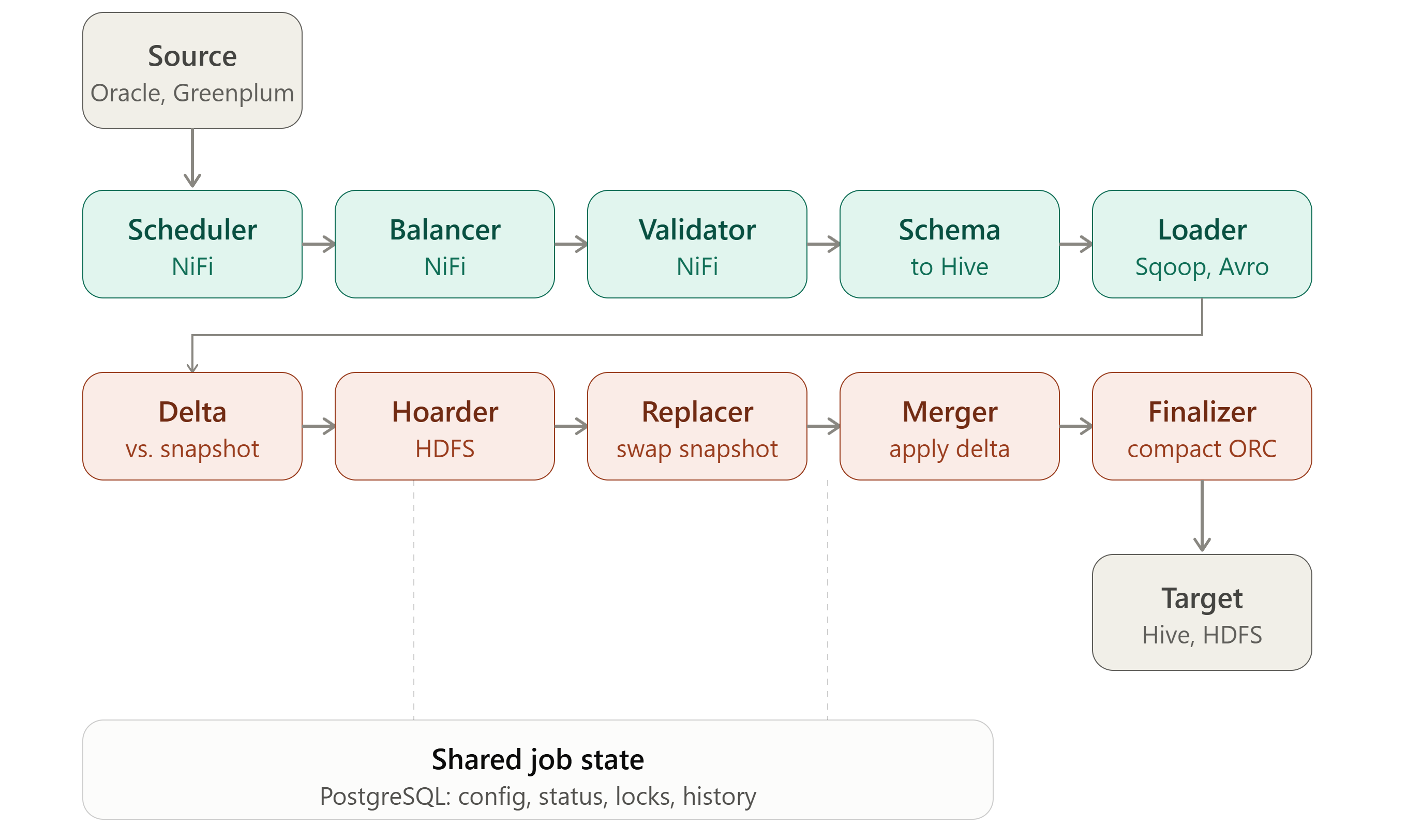
When Azati joined, the platform was already in place: specialized loaders for different source types, including a modular loader for relational databases, a snapshot-based versioning mechanism, and a metadata configuration layer in PostgreSQL. Azati’s job was not to redesign it. The job was to build new flows on top of it, connect new source types, and keep critical loads stable in production.
Every new flow had to meet five demands at once: fast delivery to the business, three different loader architectures, built-in history, stable processing at peak volumes, and production support that never paused.
The business regularly asked for new sources and additional data deliveries, and the loading process had to adapt to each one quickly:
Each loader was built for a specific source type and transfer method, but every flow had to meet the same requirements:
The business needed data not only in its current state but also as it stood in earlier periods:
The platform processed large volumes from many corporate sources every day, so a failed load could directly affect analytics and business systems:
Alongside new development, the team answered for the stability of every load already running:
Four practical reasons: experience with enterprise data platforms, a full cycle from analysis to support, speed from request to launch, and load testing before release rather than after an incident.
Azati’s engineers have worked with large data volumes, distributed storage systems, and production ETL processes, which is what complex corporate data environments demand from day one.
Azati covered the whole path of a data flow: system analysis and task definition, development, testing including load testing of the ETL cluster, and support once the flow was live.
Working inside the client’s own team let Azati’s engineers pick up new initiatives quickly, adapt to changing requirements, and shorten the time between a business request and a running flow.
For critical changes, Azati ran load tests and performance assessments in advance, so the behavior of a new flow under peak volumes was known before release.
If each request to connect a source turns into new code instead of new configuration, the bottleneck is usually the process around the platform, not the team. Tell us what your pipeline takes too long to add.
Ask us about your data platformAzati’s work on the platform ran along six lines: new flows on the relational loader, streaming, historical storage, metadata-driven configuration, load testing, and access-controlled production support. The architecture belonged to the client. The flows, tests, and support were where Azati’s engineers put in the hours.
Azati’s engineers created and connected new data flows on the platform’s existing modular loader for relational databases, inside an ETL layer built on Apache NiFi, Apache Airflow, and Apache Sqoop. Each flow went from source mapping to full, incremental, or repeat loading, and stayed under Azati’s support after launch.
For sources that deliver data continuously, Azati designed and configured real-time processing flows and connected them to the shared ETL infrastructure, so streaming data met the same reliability and quality standards as batch loads.
The platform stores periodic reference snapshots and the changes between them, so any table can be restored to its state on a chosen date. Azati didn’t build this mechanism. Azati made sure every new source used it correctly, so a new flow supported historical analysis from the day it went live.
Load parameters, processing rules, and source settings live in a separate configuration layer in PostgreSQL. That let Azati’s engineers connect new tables and adapt loads to new requirements by changing configuration, not code.
Before a new flow went to release, Azati tested loader performance under the client’s existing testing procedure: modeled load, resource usage analysis, and processing time for large data volumes.
The platform separates the rights of developers, service processes, and support specialists. Within that model, Azati handled both the development of new flows and their support in production, including on-call monitoring and defect analysis.
| Area | Azati contribution |
|---|---|
| RDBMS data flows | Created and connected new data flows on the existing modular relational database loader |
| Streaming | Designed and configured flows for sources that deliver data in real time |
| Historical storage | Applied the existing versioning and change-storage mechanism to every new flow |
| ETL configuration | Used the PostgreSQL metadata layer to manage sources and processing parameters |
| Performance control | Load tested and assessed the performance of new flows under the existing procedure |
| Platform support | Took part in production support, loader monitoring, and incident resolution |
| Loader architecture | Source type | Azati’s work |
|---|---|---|
| RDBMS | Relational databases | New flows on the existing modular loader with full, incremental, and repeat loads |
| Streaming | Continuously arriving data | Real-time processing flows connected to the shared ETL infrastructure |
| REST API | Service and external systems | Development and support of API-based integration flows under the same reliability requirements |
The platform ran inside the client’s own internal infrastructure. Access followed a role model that separates developer, service-process, and support rights, and Azati’s engineers worked under the client’s operational and access policies throughout the engagement.
Azati’s ETL engineers worked embedded inside a client-led internal ETL team of 15 to 30 people.
Azati’s engineers worked under a T&M model for 8 months, embedded directly inside the client’s internal ETL team rather than delivering as a separate external unit.
Most of the client’s own staff worked in Agile sprints, while engineers brought in for specific business requests, Azati’s team included, worked in Kanban, picking up and completing individual flow requests as they came in rather than committing to fixed sprint scope.
The engagement produced four results the business felt in daily work: a steady stream of new flows, more reliable loads, faster onboarding of new sources, and stable critical integrations.
New sources and ETL flows were connected on a regular basis at the request of internal and external business customers.
Following the platform’s architectural standards and performance control procedures reduced the risks of processing large data volumes.
Ready-made configuration mechanisms let new ETL flows launch without changing the platform’s core logic.
Production support kept business-critical integration flows running reliably.
Three advantages outlasted the engagement: a sounder base for analytics, development shaped by production, and ETL that grows through configuration rather than code.
Centralized data processing and support for historical slices improved the quality of data available to business teams. A report is only as trustworthy as the load behind it.
Azati’s part in production support meant new flows were built with the demands of live operation in mind. Engineers who answer for a failed load at night build the next flow differently.
Configuration automation and performance control gave the platform room to grow with data volumes, and turned each new request into one more configured flow instead of one more custom loader.
Azati’s engineers built new data flows on an existing enterprise ETL platform across relational, streaming, and REST API loaders. The work also covered system analysis, load testing, historical data setup, and first- and second-line production support over 8 months.
No, the platform and its loader architecture were already in place before Azati joined the client’s ETL team. Azati’s role was to develop new flows on that architecture, connect new source types, and keep critical loads stable in production.
New flows use the platform’s existing snapshot and change-storage mechanism, so a table can be restored to any chosen date. Azati configured each new source to use this mechanism from launch, which meant historical analysis worked from the first day.
Load parameters, processing rules, and source settings live in PostgreSQL, so new tables connect through configuration instead of code changes. That let Azati’s engineers adapt loads to new business requirements faster and without touching the platform’s core logic.
Every new flow was load tested under the client’s existing procedure before release, with modeled load and resource tracking. Azati measured processing time for set data volumes, loader throughput, and CPU, RAM, and queue state to catch problems before production.
The on-call model meant monitoring loads overnight, on weekends, and through holiday periods, not only during business hours. Azati’s engineers carried first- and second-line support alongside development, including incident resolution and defect analysis for critical ETL processes.
Azati worked on a Time and Material basis, embedded inside a client-led internal ETL team of 15 to 30 people. The role was hands-on flow development, testing, and production support within that team, not ownership of the whole platform.

AI analytics copilot rebuild: hybrid semantic search, MCP server, and SQL execution agent, taking adoption from zero to 25+ analysts across multiple business domains.

Retail revenue forecasting: two-circuit ML calculator (CatBoost/XGBoost/LightGBM regression plus weak-store classifier), 30.1% WAPE, built solo in 10 weeks with Claude Code.

Influencer marketing platform modernization: 5+ applications, ~200K creators & 12K+ advertisers across 18 markets — React Native upgrades, AI-powered campaign analytics, contract workflows, and internationalization delivered alongside feature development without a roadmap freeze.

Azati helped a European online auction marketplace resume active development of its supplier platform while modernizing the underlying architecture.

DIY retail logistics QA: pickup point exclusion testing, delivery reason tracking across 3 backend services, and third-party carrier integration testing.
B2B automotive parts portal engineering: database architecture unblocked via ADR, multi-region order management, and vendor API integrations delivered on a live platform.
Last updated
