Incremental modernization instead of platform replacement
Azati extended and modernized an operational enterprise platform without interrupting engineering workflows or investment governance.
How to improve engineering project governance without replacing an existing enterprise platform?
Azati modernized an enterprise platform for investment project governance by improving engineering information management, project readiness workflows, approvals, reporting, secure document governance, and collaboration while preserving operational continuity. The platform provided engineering teams, experts, and management with a single source of truth for project requirements, documentation, reviews, approvals, and investment readiness.
core platform domains enhanced
new export formats supported
oil and gas environment with information security requirements


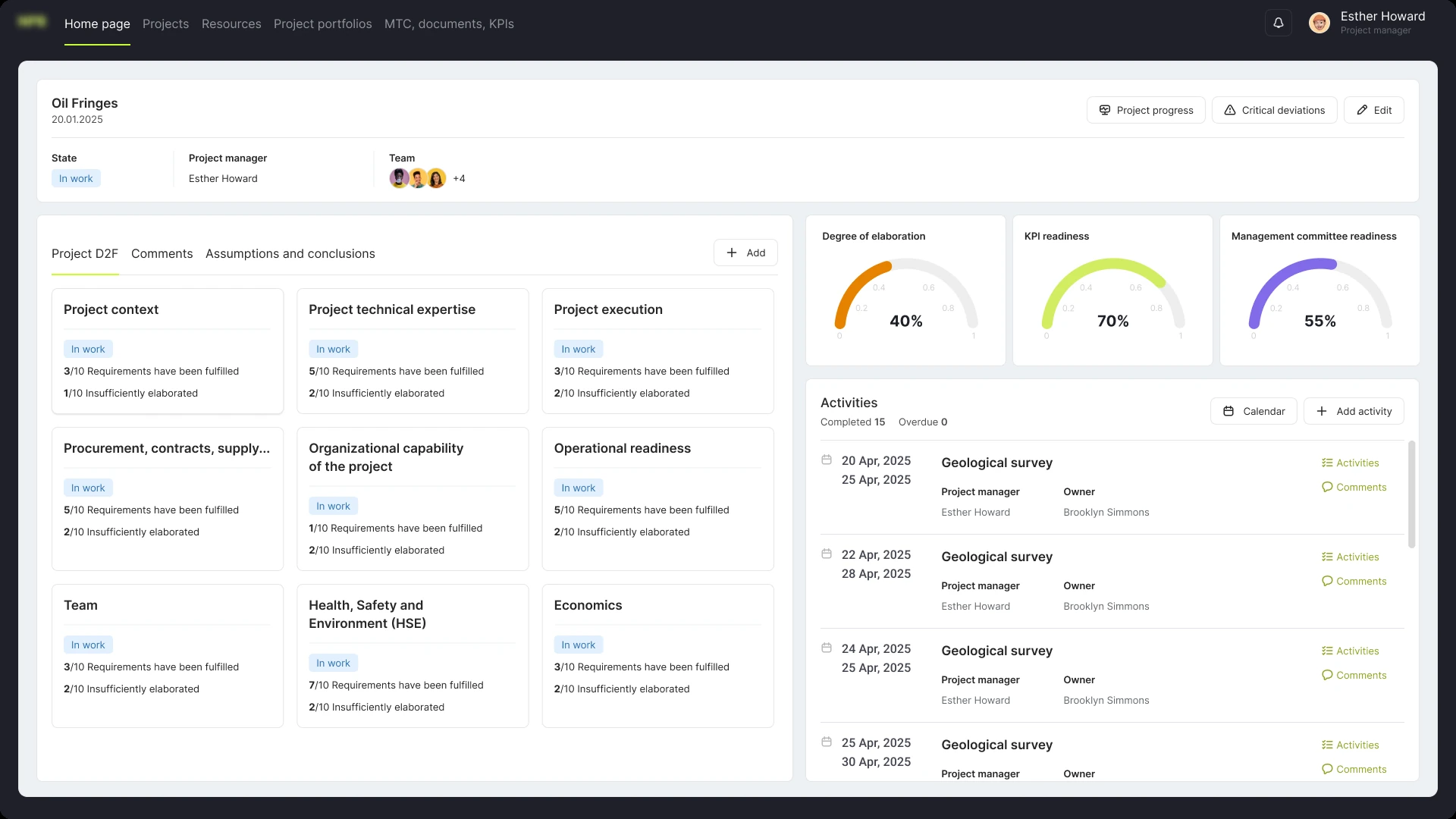
Azati modernized an established enterprise platform used to govern large engineering investment projects throughout their lifecycle. The platform centralized project requirements, engineering documentation, expert remarks, project readiness assessments, approvals, and reporting within a single environment, reducing reliance on fragmented documents, spreadsheets, and emails.
The engagement combined stabilization of inherited functionality with incremental platform modernization and delivery of new business capabilities.
Project stakeholders lacked a reliable view of whether engineering requirements had been fulfilled, expert remarks resolved, documentation completed, and projects were sufficiently mature to progress through investment approval stages.
Large engineering initiatives involve numerous stakeholders, approvals, and supporting documents. Without centralized information management, project participants struggle to maintain visibility into project status, documentation, and project maturity indicators (PDRI), increasing coordination overhead and slowing decision-making.
The organization needed controlled processes for storing, reviewing, exporting, and sharing project information. Maintaining consistency and accessibility of documentation became increasingly important as projects evolved and demanded multiple teams.
Enhancements were necessary to project review workflows and mechanisms for managing comments and approvals across participants.
Existing PDF generation mechanisms created operational difficulties and required additional effort to align technical capabilities with business expectations.
Azati extended and modernized an operational enterprise platform without interrupting engineering workflows or investment governance.
Rather than developing isolated business applications, Azati has extensive experience modernizing platforms responsible for engineering information management, document governance, approvals, and enterprise collaboration.
The engagement was delivered within a controlled enterprise environment governed by information security requirements and role-based access policies.
Azati helps industrial organizations modernize project portfolio management systems, strengthen document workflows, and improve collaboration across engineering and operational teams.
Discuss your enterprise platformAzati expanded the functionality of a platform that organizes engineering engagements, supports documentation workflows, manages approvals, and provides access to project information. The team stabilized previously implemented functionality, optimized inherited components, and continued platform evolution without disrupting ongoing delivery.
The Azati team introduced AI-assisted similarity analysis that helped engineering experts identify comparable historical remarks across projects. By surfacing related engineering knowledge, the platform helped reviewers identify related historical engineering remarks more efficiently.
The platform provided stakeholders with centralized access to project information, responsibilities, and project readiness indicators and maturity assessments. Azati enhanced capabilities supporting information transparency and governance throughout the project lifecycle.
Project teams relied on structured docflows to maintain consistency and accessibility of engineering information. Azati improved information governance mechanisms and operational efficiency across document-driven processes.
The platform coordinated expert reviews, engineering remarks, approval workflows, and cross-functional collaboration throughout the project preparation phase. Azati expanded remark management, review processes, and collaboration capabilities, helping teams resolve issues more efficiently before projects advanced to subsequent investment stages.
Given that the project information required controlled access, the platform used role-based mechanisms to regulate interactions and responsibilities.
Reliable generation of project documentation was an important requirement for operational processes. Azati enhanced the mechanisms behind producing business-ready outputs and increased confidence in document-driven workflows.
The engagement supported scalable architectural approaches intended to facilitate future platform growth and maintainability.
| Area | Azati contribution |
|---|---|
| Reporting | Added Excel export functionality |
| Documentation | Supported Word and PDF output generation |
| Approval workflows | Implemented project remark and comment approval mechanisms |
| Collaboration | Added export capabilities for project remarks |
| Security | Implemented role-based access mechanisms |
| Reliability | Improved legacy PDF conversion processes |
| AI | Implemented AI-assisted similarity analysis for engineering remarks |
| Architecture | Worked with GraphQL, Hasura, Keycloak, and Spring components |
| Quality assurance | Performed testing and validation activities |
| Delivery | Worked within an Agile process using a cross-functional team |
Though DITA-OT was a mature technology, Azati efficiently aligned generated outputs with modern business requirements.
The Azati team followed the client environment's information security regulations governing access control and software usage practices.
Azati ensured the enhancements integrated with an established platform while supporting operational continuity.
Some functionality required remediation and stabilization following earlier development efforts, particularly around document generation processes.
The engagement required the team to quickly master complex engineering investment processes, including project requirements management, expert reviews, project maturity assessments, and enterprise document governance.
Business priorities evolved throughout delivery, requiring continuous refinement of functionality while maintaining release schedules and platform stability.
Enterprise project modernization doesn't require replacing operational platforms. Azati helps industrial organizations improve engineering information management, project governance, document workflows, approvals, and collaboration through incremental modernization that powers operational continuity while establishing a scalable foundation for future digital transformation.
Discuss your modernization initiative| Area | Achievement |
|---|---|
| Engagement duration | 4 months |
| Specialists involved | 3 |
| Core platform domains enhanced | 6 |
| New export formats supported | 3 |
| Approval workflow capabilities expanded | Yes |
| Legacy PDF conversion issues addressed | Yes |
By enhancing reporting and information management capabilities, Azati increased visibility across projects and supported faster access to information required for reviews and operational decision-making.
Through expanded approval workflows and comment management capabilities, Azati improved collaboration and reduced friction between stakeholders involved in project reviews.
Improvements to document generation mechanisms enabled more efficient preparation and distribution of project information across operational processes.
Controlled access mechanisms and structured workflows enhanced information governance and helped maintain consistency throughout the project lifecycle.
By modernizing an existing enterprise engineering governance platform rather than replacing it, Azati helped improve transparency across investment project preparation, strengthen engineering information governance, and reduce coordination overhead, supporting continued platform evolution.
The AI capabilities developed during the engagement were later showcased within the client's internal AI innovation program, demonstrating the practical application of AI in engineering project management workflows.
Centralized reporting and structured workflows improved access to information required for project reviews and decision-making.
Approval and remark-management capabilities supported smoother coordination throughout project workflows.
Maintainability-focused decisions established a scalable basis for continued digital transformation efforts.
Azati worked as an embedded engineering partner within the client's cross-functional delivery organization, contributing backend engineering, frontend development, and quality assurance while supporting continuous releases and evolving business priorities.
Explore our recent projects and see how Azati delivers measurable results for the clients.
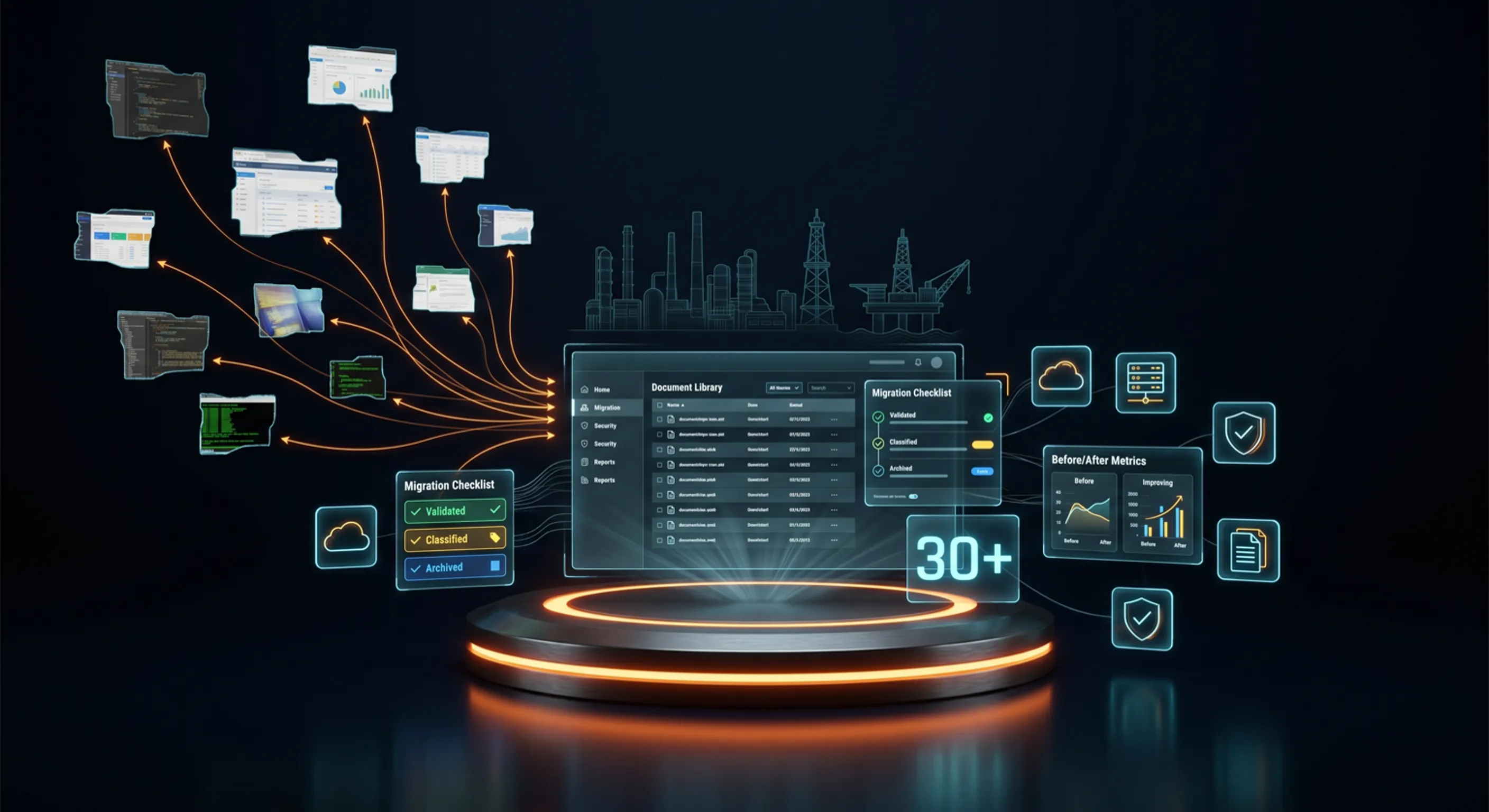
A major oil & gas enterprise needed to consolidate more than 30 independently developed SharePoint portals into a unified collaboration environment. Years of decentralized development had created inconsistent navigation, unsupported customizations, duplicate content, undocumented dependencies, and fragmented governance. Before migration could begin, the organization required a structured assessment of its legacy environment to reduce operational risks and establish a reliable modernization strategy.
Azati conducted a comprehensive migration assessment combining business analysis, legacy portal auditing, content governance, functional validation, and migration documentation. The engagement established a standardized migration framework that enabled informed modernization planning across hundreds of thousands of enterprise content entities.
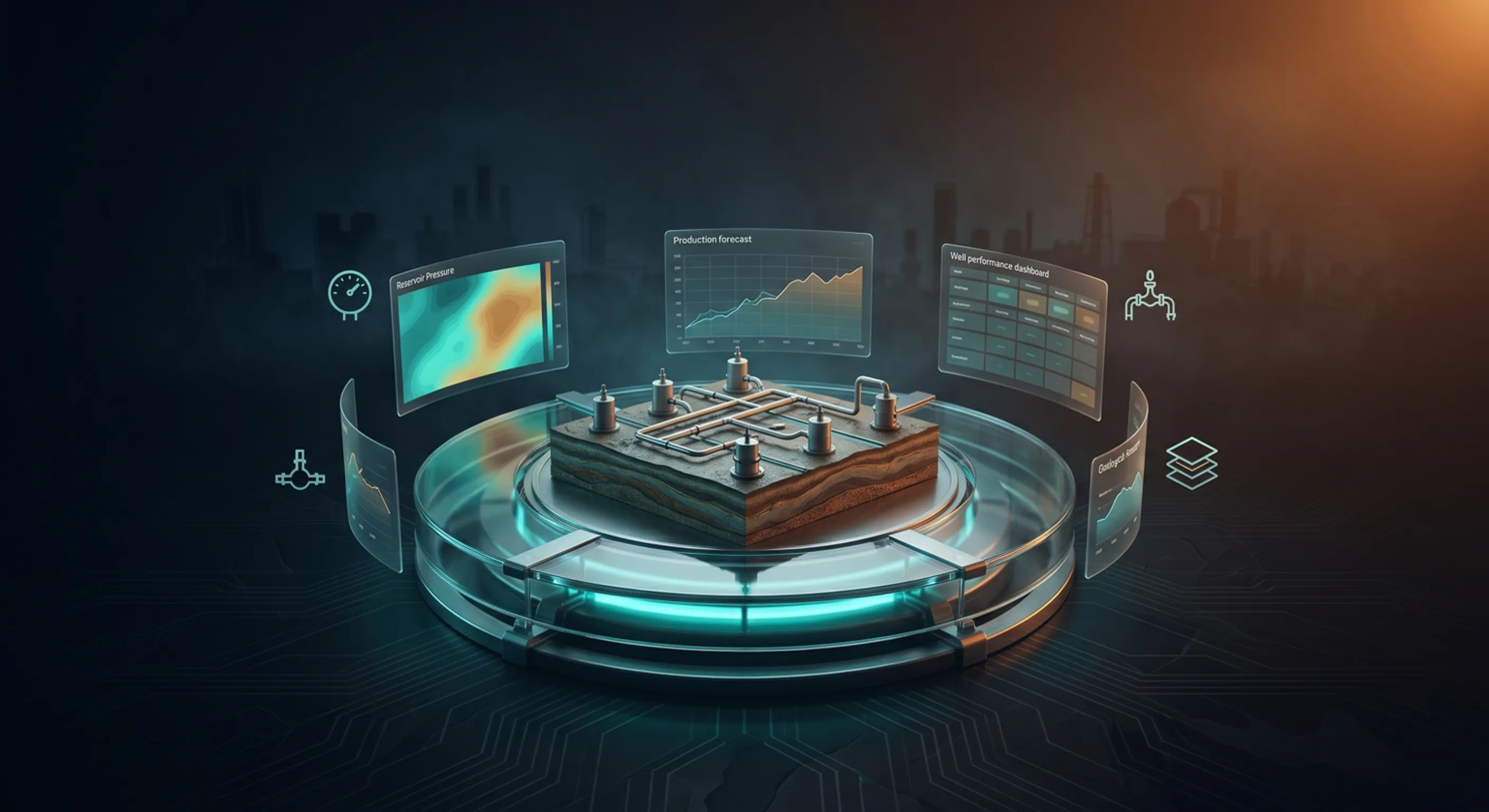
The client required a stable, production-grade platform for petroleum analytics to handle highly complex engineering calculations involving forecasting, well interaction, optimization, and beyond. The existing analytical logic was unstable, poorly validated, and struggled with complex dependencies, creating risks that could directly affect critical production planning and operational decisions.
Azati built a modular, Python-based petroleum analytics platform with isolated services for production forecasting, well interaction, and engineering diagnostics. Leveraging software engineering, advanced mathematical modeling, and QA-driven validation, the platform allows specialists to process historical data and analyze complex geological dependencies despite evolving requirements.

A major oil and gas enterprise required a centralized platform for construction cost estimation and tender preparation across large industrial infrastructure projects. The system relied on interconnected pricing catalogs, coefficient logic, material resource statements, and project-specific calculation rules spanning multiple business processes. With part of the platform already delivered by another vendor, the client needed to stabilize inherited functionality, preserve cross-module compatibility, and accelerate development without compromising calculation accuracy or release quality.
Azati joined the project to develop and stabilize the enterprise estimation platform, delivering new calculation capabilities while validating inherited business logic. The team implemented core pricing, coefficient, and material management modules, established repeatable regression testing, and supported enterprise release validation in a dynamic multi-vendor environment.
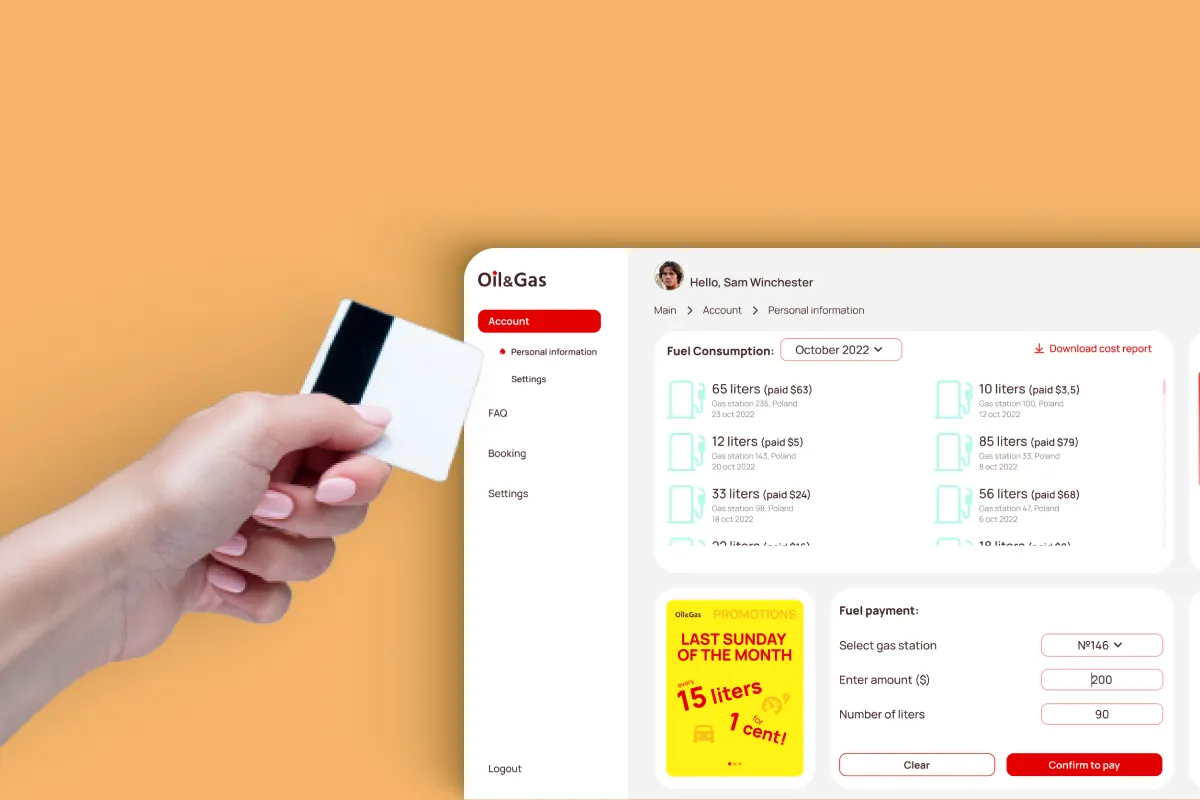
A major oil and gas company needed to improve its corporate fuel card management platform to streamline customer self-service, automate document processing, and improve operational efficiency. The existing platform faced development process challenges, inconsistent deployment environments, and quality management issues while supporting critical services such as transaction reporting, card management, and customer request processing integrated with Siebel CRM.
Azati optimized the enterprise web platform by enhancing customer-facing fuel card services, automating document workflows, refining transactional reporting, and improving development and quality assurance processes. The engagement combined platform enhancements with architecture improvements that increased reliability, maintainability, and delivery efficiency.
The client needed to optimize document generation and management across internal enterprise systems. Their existing processes relied on fragmented integrations between SAP ERP and a document generation platform, causing delays, manual overhead, inconsistent data exchange, and frequent processing errors. The client required a middleware integration layer capable of securely orchestrating the docflow while supporting different protocols, formats, and business logic requirements.
Azati developed a middleware data bus integrating SAP ERP with the client's document generation system. Using Apache Camel, Spring, and SOAP web services, the solution automated the docflow and enabled reliable real-time data exchange between systems. The platform standardized message processing, automated document-related operations, transformed and enriched incoming data, improved validation and error handling, and ensured secure communication between systems.



Last updated
