AI Platform Architecture for Patent and Biological Sequence Intelligence

How do you architect one AI platform that runs identically in the cloud and inside a private research lab?

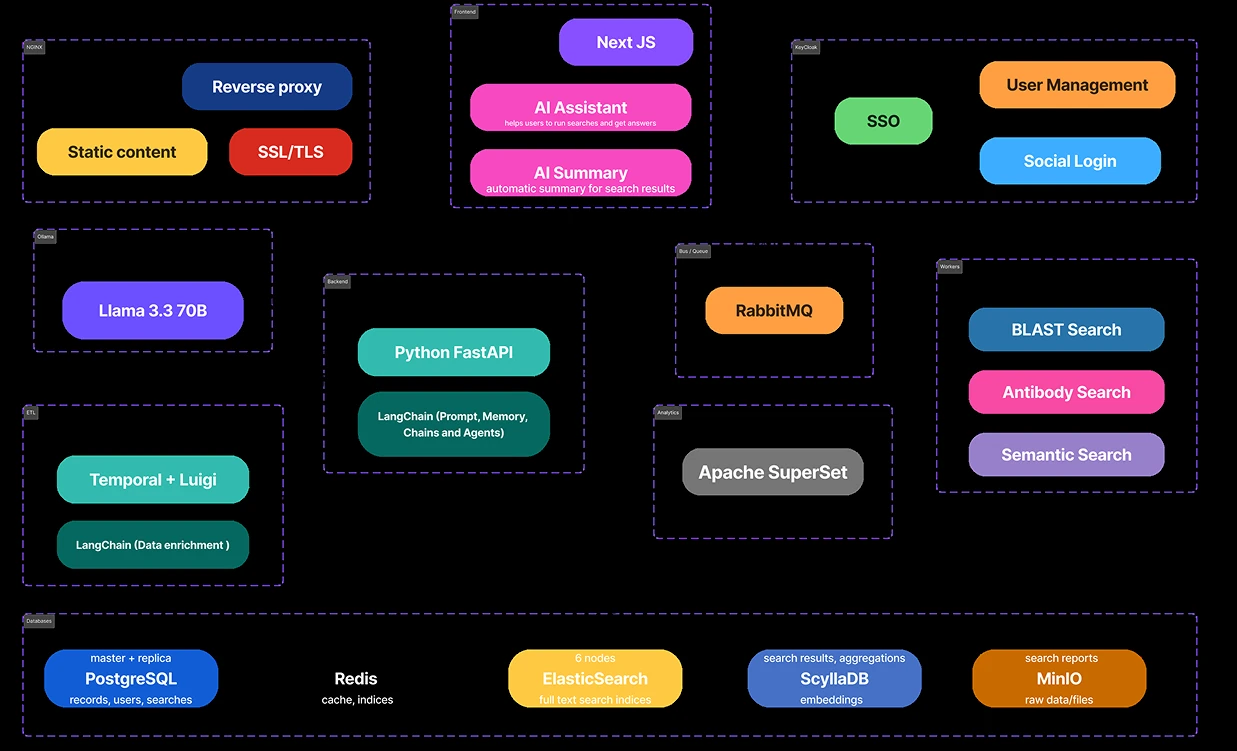
Azati architected and built the AI platform powering a biotechnology and intellectual property analytics company's patent and sequence research tools. The engagement centered on system architecture: a hybrid-ready microservices design with open-source cloud parity, a pluggable LLM layer, AI pipeline orchestration, and hybrid vector search, built to run identically on cloud infrastructure or fully on-premise for research environments with strict data governance needs.

Architect my AI research platform
70%

reduction in manual annotation time

90%+

semantic search accuracy across patent and sequence data

100%

hybrid-ready deployment across cloud and on-premise infrastructure

Technologies used

TensorFlow
TensorFlow
Keras
Keras
PostgreSQL
PostgreSQL
Elasticsearch
Elasticsearch
RabbitMQ
RabbitMQ
Docker
Docker
Kubernetes
Kubernetes
Keycloak
Keycloak

Motivation

A biotechnology and IP analytics company needed to turn a flood of unstructured patent documents and biological sequence data, spread across PDF, XML, FASTA, and GenBank formats, into something researchers and IP analysts could actually search, understand, and act on quickly. The functional need was clear. The harder problem was architectural: the platform had to work for research teams operating on public cloud infrastructure and for clients whose data governance requirements meant the system had to run entirely on-premise, with no cloud dependency at all, using the same codebase.

Azati architected the platform around that constraint from the start: a microservices design built on open-source components with direct cloud-service parity, a pluggable LLM layer that supports open-weight models, and orchestrated AI pipelines for ingestion, enrichment, and search, all deployable identically through Docker and Kubernetes regardless of where the infrastructure actually lives.

Architectural challenges

Challenge 01

Data integration and heterogeneity

Patent documents and biological sequences arrived in fundamentally different formats, PDF and XML for patents, FASTA and GenBank for sequences, updated continuously and requiring standardized ingestion:

  • Multiple heterogeneous source formats requiring unified ETL pipeline architecture
  • Schema mapping across incompatible document and sequence structures
  • Data validation and cleaning at terabyte-to-petabyte scale
  • Continuous updates requiring ingestion pipelines that never fully stop
#1
Challenge 02

Intelligent query and interpretation at scale

Simple keyword matching could not support the kind of research queries patent analysts and scientists actually needed to run:

  • Hybrid search combining full-text and vector-based semantic matching
  • Embedding pipeline design for both patent text and biological sequence data
  • Query orchestration across multiple underlying search and retrieval systems
  • Context-aware ranking that reflects domain-specific relevance, not generic relevance
#2
Challenge 03

Summarization and contextualization of dense technical content

Patent claims and sequence annotations are dense, technical, and often reference other documents, which made naive summarization unreliable:

  • LLM inference architecture capable of handling long, technical source documents
  • Context window management across multi-document references
  • Result aggregation that preserves technical accuracy over generic fluency
#3
Challenge 04

Scalable AI architecture without vendor lock-in

The platform had to be deployable in environments the client did not fully control and could not assume would ever have cloud connectivity:

  • Deployment-agnostic architecture supporting both cloud and fully on-premise operation
  • Containerization as the standard unit of deployment across all environments
  • Open-source parity for every cloud-native service used in the platform
  • No hard dependency on any single cloud vendor's proprietary services
#4

Key architectural decisions behind the platform

Microservices-based design

The platform is decomposed into independently deployable services rather than a single monolithic application, letting ingestion, search, summarization, and orchestration scale and evolve separately without one component's load or failure affecting the others.

Open-source cloud parity

Every cloud-native capability in the platform, object storage, relational data, search and vector indexing, has a self-hosted open-source equivalent in active use: MinIO in place of proprietary object storage, PostgreSQL for structured data, Elasticsearch paired with a vector database for search. The same platform runs on public cloud infrastructure or entirely within a client's own data center.

AI pipeline orchestration

Luigi coordinates the ingestion, enrichment, embedding, and indexing pipelines as managed, observable workflows rather than as a collection of scripts run manually or on ad hoc schedules.

Hybrid vector search

Elasticsearch handles traditional full-text search while a vector database handles semantic similarity over LLM-generated embeddings, combined into a single hybrid search layer that matches both exact terminology and conceptual meaning.

Flexible deployment

Docker and Kubernetes containerization, provisioned through Ansible, make the deployment target, cloud, on-premise, or a mix of both, a configuration choice rather than an architectural rewrite.

Pluggable LLM layer

A model abstraction layer sits between the application logic and the underlying language models, currently LLaMA and Mistral, so models can be swapped or fine-tuned for a specific research domain without touching the rest of the system.

Need an AI platform that works in the cloud and behind your firewall?

Deployment-agnostic architecture, open-source cloud parity, and pluggable LLMs are what let this platform run identically anywhere. Let's talk about your infrastructure constraints.

Architect my AI research platform

How the platform is structured module by module

Five modules cover the platform end to end, from conversational research assistance down to the storage and infrastructure layer everything else runs on.

01

AI Assistant Module

A conversational research assistant built on a multi-agent pattern using LangChain, letting researchers query patent and sequence data in natural language and receive answers grounded in the platform's underlying search and retrieval layers rather than a generic language model response.

Key capabilities:
  • LangChain-based multi-agent conversational architecture
  • Natural language querying over patent and sequence data
  • Answers grounded in retrieved platform data, not model memory alone
02

AI Summary Module

Automated summarization of patent claims and sequence annotations using template-driven prompting and fine-tuned LLMs, producing consistent, structured summaries instead of free-form text that varies in format from one document to the next.

Key capabilities:
  • Template-driven summarization for consistent output structure
  • Fine-tuned LLMs for domain-specific technical summarization
  • Structured summaries suitable for downstream automated processing
03

AI Dataset Analysis and Enhancement Module

Machine learning-based classification and clustering applied across the ingested dataset, along with cross-domain entity recognition that links related patent claims and sequence records that would otherwise remain disconnected.

Key capabilities:
  • ML-based classification and clustering of ingested records
  • Cross-domain entity recognition linking patents and sequences
  • Dataset enhancement supporting more accurate downstream search
04

Integration and Workflow Module

An orchestration framework connecting the platform's internal services, using RabbitMQ for asynchronous task distribution and Keycloak for centralized authentication and authorization across every service in the platform.

Key capabilities:
  • RabbitMQ-based asynchronous service orchestration
  • Keycloak-based centralized authentication and access control
  • Workflow coordination across ingestion, search, and summarization services
05

Data Storage and Infrastructure Module

The storage and infrastructure foundation the rest of the platform depends on: PostgreSQL, MinIO, and Elasticsearch for data persistence and search, deployed and scaled through Kubernetes across whatever environment the platform is running in.

Key capabilities:
  • PostgreSQL for structured data persistence
  • MinIO for open-source, S3-compatible object storage
  • Elasticsearch for search infrastructure
  • Kubernetes-based deployment and scaling across environments

What Azati architected

AreaAzati contribution
System architectureDesigned a microservices-based, deployment-agnostic platform architecture
Cloud parityBuilt open-source equivalents for every cloud-native service used
LLM layerImplemented a pluggable model abstraction layer supporting LLaMA and Mistral
Pipeline orchestrationBuilt Luigi-based orchestration for ingestion, enrichment, and indexing
SearchImplemented hybrid full-text and vector search across patent and sequence data
DeploymentContainerized the platform for identical cloud or on-premise deployment
Access controlImplemented Keycloak-based authentication and authorization

Security

Access control across every service in the platform runs through Keycloak with OAuth2, giving the client centralized authentication and authorization rather than per-service credentials. For clients with strict data governance requirements, the platform's open-source cloud parity means the entire system, data storage, search, and AI inference, can run fully on-premise with no data ever leaving the client's own infrastructure.

Results & architectural impact

70% reduction in manual annotation time

Automated metadata enrichment and classification took over work that previously required manual review of patent claims and sequence records one at a time.

90%+ semantic search accuracy

Hybrid full-text and vector search across patent and sequence data consistently returns results that match on meaning, not just matching terminology, which is what a 90%+ accuracy figure actually reflects in a domain this technical.

Fully hybrid-ready deployment

The same platform, unmodified, runs on public cloud infrastructure or entirely on-premise, giving the client flexibility to serve research clients with different data governance requirements without maintaining two separate systems.

A pluggable foundation for future AI models

The model abstraction layer means the platform isn't locked to LLaMA and Mistral specifically. As better or more specialized open-weight models become available, they can be integrated without rearchitecting the application layer around them.

Strategic wins

What this engagement demonstrates:

Deployment flexibility has to be designed in, not added later

A platform built cloud-first and later ported to on-premise almost always carries architectural assumptions that don't survive the transition. Designing for open-source cloud parity from the first architectural decision is what made identical cloud and on-premise deployment achievable rather than aspirational.

Hybrid search beats choosing between full-text and semantic

Full-text search alone misses conceptually related results phrased differently. Vector search alone can drift from exact technical terminology that matters in patent and sequence work. Combining both into one hybrid layer is what got semantic search accuracy above 90% in a domain where precision actually matters.

A pluggable LLM layer is a hedge against a fast-moving model landscape

Open-weight models capable enough for domain-specific fine-tuning are improving quickly. Building the application layer against a model abstraction rather than a specific LLM is what keeps the platform from needing a rearchitecture every time a better model becomes available.

The described expertise is relevant for

  • AI platform architecture for regulated or data-sensitive research environments
  • Hybrid cloud and on-premise AI deployment engineering
  • Microservices-based AI system design
  • Pluggable, model-agnostic LLM architecture
  • Hybrid full-text and vector search implementation
  • AI pipeline orchestration for large-scale unstructured data
  • Life sciences and IP analytics AI platform engineering

Screenshots

AI Platform Architecture for Patent and Biological Sequence Intelligence

Azati's related life sciences and bioinformatics expertise

Explore our successful projects and see how Azati delivers measurable results for our clients.

AI-Powered Patent & Sequence Intelligence Platform

AI-Powered Patent & Sequence Intelligence Platform

50M+ patent documents and biological sequences processed
72% reduction in manual annotation, summarization, and metadata work
91% search accuracy and result relevance via semantic and vector retrieval
  • Python
  • Elasticsearch
  • Vector Database
  • LLM Embeddings

⚡ Pain Points We Tackled

The client needed to process massive volumes of unstructured patent documents and biological sequence data, spread across PDF, XML, FASTA, and GenBank formats and updated continuously, while ensuring high-quality metadata, scalable processing, efficient retrieval, and compliance with global IP standards. Processing terabyte-to-petabyte-scale datasets required large-scale ingestion, normalization, cleaning, and indexing pipelines capable of handling diverse and unstructured data, automating workflows that were previously labor-intensive and manual.

Our Approach

Azati developed an AI-driven platform that standardizes heterogeneous datasets, removes duplicates, cleans corrupted records, and prepares them for AI-powered search and metadata enrichment. A dedicated enrichment module restores lost connections between sequences, annotations, and patent claims, while a semantic and similarity-based search layer built on Elasticsearch, vector databases, and LLM embeddings enables fast, context-aware retrieval across patents and sequences.

Applied Methods and Practices

  • Data standardization and cleaning across PDF, XML, FASTA, and GenBank formats
  • Metadata enrichment restoring connections between sequences, annotations, and patent claims
  • Semantic and similarity-based search via Elasticsearch and vector databases
  • LLM-powered components for sequence and patent claim summarization
  • Context-aware ranking for faster, more accurate retrieval

Solution Features

  • Massive-scale processing: over 50 million patent documents and biological sequences processed through the platform
  • Reduced manual workload: 72% reduction in manual annotation, summarization, and metadata work
  • High search accuracy: 91% search accuracy and result relevance through combined semantic and vector retrieval
  • Faster discovery: researchers and IP analysts gain actionable insights faster and with greater confidence in data quality
NLP Solution for Pharmaceutical Marketing

NLP Solution for Pharmaceutical Marketing

95% key phrase coverage in doctors’ responses
50+ identification actionable market insights
45% improved campaign targeting accuracy
  • Python
  • NLP
  • Computer Vision
  • Machine Learning

⚡ Pain Points We Tackled

Pharmaceutical marketing teams needed to correlate physician questionnaire responses and field feedback with marketing strategy performance, a process that was manual, slow, and difficult to scale across large volumes of unstructured text and reporting materials. Generating consistent, evaluable marketing assessment reports from this data required both language understanding and visual document processing working together.

Our Approach

Azati developed an AI and computer vision solution that automates the analysis of physician questionnaires and correlates feedback patterns with marketing strategy outcomes. The system combines NLP-based text mining with automated report generation, producing comprehensive evaluation reports for pharmaceutical marketing teams without manual data correlation.

Applied Methods and Practices

  • NLP-based analysis of physician questionnaires and feedback text
  • Correlation modeling between feedback patterns and marketing strategy performance
  • Computer vision components for processing report and document inputs
  • Automated report generation replacing manual evaluation workflows

Solution Features

  • Improved marketing effectiveness: automated feedback correlation boosted marketing strategy effectiveness by 45%
  • Faster analysis cycles: automated questionnaire and feedback processing replaced manual review
  • Consistent reporting: automated generation of evaluation reports for pharmaceutical marketing teams
  • Scalable insight generation: the system processes feedback volumes that manual analysis could not keep pace with
BLAST Algorithm Enhancement for Short Sequence Search

BLAST Algorithm Enhancement for Short Sequence Search

3x more relevant matches retrieved
55% reduction in false negatives in primer-based searches
40% faster end-to-end sequence analysis workflow due to automation
  • Python
  • BLAST
  • Bioinformatics Algorithms

⚡ Pain Points We Tackled

A biotechnology corporation providing access to genomic sequence information struggled to get meaningful results when running short DNA/RNA primer sequences, under 20 bases, through the standard BLAST algorithm. The default configuration prioritized longer sequences, causing missing matches and incomplete alignments that slowed genomic analysis and undermined primer-based research critical to personalized medicine work. Short sequences also carried a heavy risk of false negatives due to BLAST's probability-driven scoring model, leaving biologically meaningful partial matches undetected.

Our Approach

Azati's engineering team implemented changes to the BLAST algorithm's codebase to support dynamic parameter tuning based on input sequence length, along with enhanced filtering and sensitivity tuning to surface previously hidden alignments without cluttering results with noise. The customized configuration lowered significance thresholds specifically for short sequences and automated the tuning process so researchers no longer needed to manually configure parameters for each primer-based search.

Applied Methods and Practices

  • Custom optimization layer over the BLAST algorithm codebase
  • Dynamic parameter tuning based on input sequence length
  • Enhanced sensitivity filtering for sub-20-base sequences
  • Automated configuration removing the need for manual parameter tuning

Solution Features

  • Reliable short-sequence matching: primer sequences under 20 bases now return meaningful, complete alignments
  • Fewer false negatives: enhanced sensitivity tuning surfaces biologically meaningful partial matches previously missed
  • No manual tuning required: dynamic parameter adjustment removes a repetitive manual configuration step for researchers
  • Stronger foundation for personalized medicine research: more reliable primer-based analysis supports downstream genomic research
Semantic Search Engine for a Bioinformatics Company

Semantic Search Engine for a Bioinformatics Company

27 ms average time to process a search query and return results
3 min time required to retrain neural networks on new datasets
150,000+ blood samples effectively analyzed and tagged
  • Python
  • Word2Vec
  • Redis
  • RESTful Microservices

⚡ Pain Points We Tackled

A bioinformatics company needed a search engine capable of understanding the actual meaning behind research queries across vast, complex scientific datasets, rather than matching on exact keywords. Multiple naming conventions and variations in disease names across the data hindered precise tagging and search accuracy, and the project had no pre-labeled sample data available for algorithm training, a significant obstacle for building an accurate matching system from scratch.

Our Approach

Azati built the training dataset from open-source life sciences documents, analyzing hundreds of thousands of records to construct a comprehensive thesaurus and training a custom Word2Vec model to detect and map synonyms across disease naming conventions. The team developed intelligent matching and query analysis modules and implemented RESTful microservices with Redis caching for scalable, efficient search performance, along with a pluggable module for automatic tagging of blood samples based on their descriptions.

Applied Methods and Practices

  • Custom Word2Vec model trained on life sciences documents for synonym detection
  • Comprehensive thesaurus built from hundreds of thousands of scientific records
  • Intelligent matching and query analysis modules for semantic search
  • RESTful microservices with Redis caching for scalable query performance
  • Pluggable automatic tagging module for blood sample descriptions

Solution Features

  • High-confidence auto-tagging: blood sample tagging module assigns tags with roughly 98% confidence
  • Training data built without labeled samples: constructed a working training dataset entirely from open-source life sciences documents
  • Improved search precision: semantic matching of queries to datasets significantly reduced irrelevant results
  • Scalable query performance: RESTful microservices and Redis caching support fast search across large scientific datasets

Last updated

Got a job for Azati? Let’s talk business!

This site is protected by reCAPTCHA and the Google Privacy Policy and Terms of Service apply.

What's next?

  • 1. Tell Us Your Story
    Describe your project. We come back within 24 hours with team availability and a rough plan. NDA on request before the first call.
  • 2. Get Your Roadmap
    Receive a detailed proposal with scope, team composition, timeline, and costs tailored to your goals.
  • 3. Start Building
    Azati aligns on details, finalize terms, and launch your project with full transparency.