Improved Search Efficiency
Advanced algorithms and a centralized portal reduced the time researchers spent finding and analyzing patent sequences.
Development of an online data source for sequence information, designed to meet scientists' and researchers' IP search needs, including patentability, Freedom-to-Operate (FTO), patent infringement, validity, and business intelligence.
faster query processing
coverage of published patent sequences since 1982
reduction in researcher effort


Researchers and IP experts struggled with fragmented, incomplete, and slow access to patent sequence data, often needing to query multiple databases manually, which caused delays, inefficiencies, and missed insights. The goal was to create a centralized, comprehensive, and user-friendly genetic analysis portal that enables fast and accurate searches, simplifies data filtering and reporting, and ensures same-day access to the latest published sequences, directly addressing researchers’ pain points and accelerating scientific and IP workflows.
Intellectual property experts state that about 80% of the information published in a patent document is not available anywhere else, and workflows often led to incomplete or overwhelming search results. Azati addressed this by developing a centralized, comprehensive database that integrates various patent sequences, ensuring thorough and accurate search results.
The time taken for results analysis inhibited the IP sequence search process, and the overwhelming volume of results slowed down the ability to sift through data efficiently. Azati streamlined this process by implementing advanced search algorithms and filtering tools, drastically reducing analysis time and improving efficiency.
Multiple databases had to be accessed, creating slow, inefficient, and expensive workflows for researchers and experts, with difficulties in sharing and reporting results. We solved this by consolidating data into a single, user-friendly portal, offering easy access to relevant information and advanced reporting capabilities.
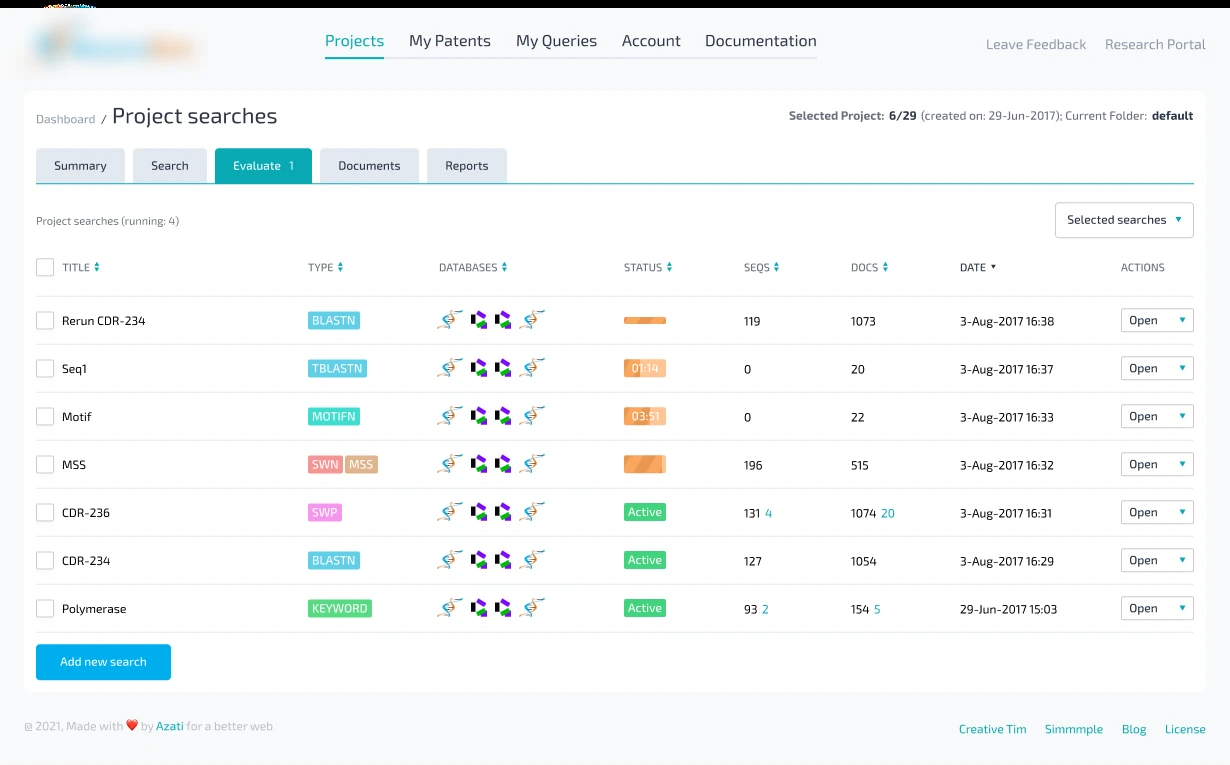
Developed the SequenceBase IP Research Portal, providing a single access point to genetic sequences from published applications and patents dating back to 1982, including organism names, sequence length, modification tables, and bibliographic data.
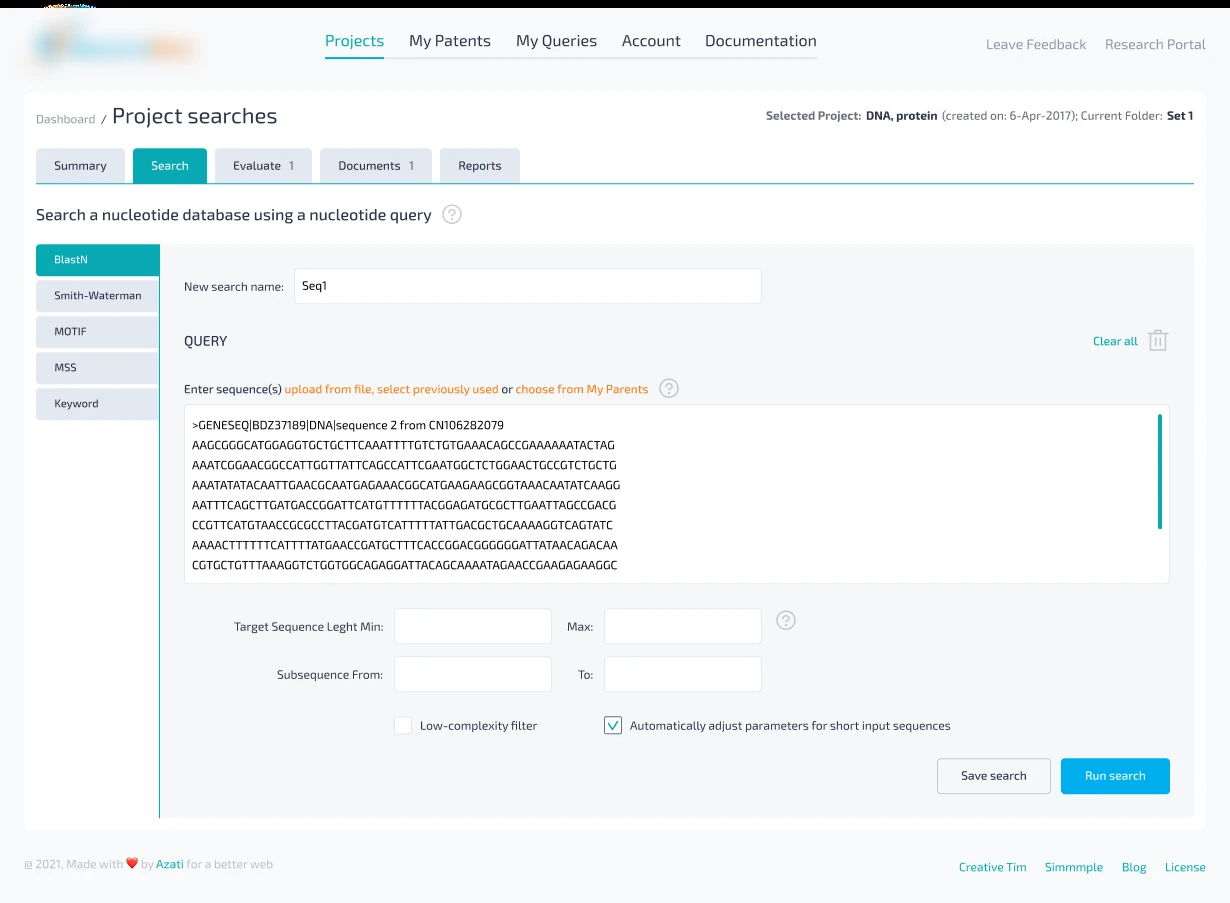
Integrated multiple search algorithms, including BLAST, Smith-Waterman, Multiple Sequence Search, and MOTIF, to enable flexible, accurate, and thorough sequence searches across patents and applications.
Implemented cloud-based distributed processing and scaling technologies to handle growing data volumes, ensure fast performance, and provide same-day data delivery to users.
Automated daily updates and leveraged a big data strategy to provide rapid access to the latest sequences, ensuring researchers always have the most current and relevant information.
Bring your complexity. We'll bring the plan. Tell us about your project and we'll get back within one business day.
Inquire for more infoA comprehensive database that contains sequences from patent documents, including related information such as organism names, sequence lengths, and modification tables. Supports full bibliographic data, including inventor names, assignees, and publication numbers.
Enables researchers to perform precise and comprehensive sequence searches using algorithms like BLAST, Smith-Waterman, Multiple Sequence Search, and MOTIF. Facilitates both exact and similarity-based searches across large datasets.
Provides advanced filtering and reporting tools to allow users to narrow down search results, analyze patterns, generate reports, and export data for further research or patent evaluation.
Leverages cloud technologies for scalability, fast data processing, and high availability. Ensures the portal can handle large and growing datasets while providing a smooth and responsive user experience.
Advanced algorithms and a centralized portal reduced the time researchers spent finding and analyzing patent sequences.
Cloud-based infrastructure and big data strategy enabled same-day updates, improving research timeliness and workflow efficiency.
Scientists gained reliable, comprehensive, and accessible IP sequence data, supporting more accurate patentability analysis and bioinformatics research.

Embedded healthcare engineering: React, React Native, and React Native Web across patient and clinician workflows, ~4,800 engineering hours over 32+ months, zero delivery disruptions.

AI patent and sequence intelligence architecture: microservices design, open-source cloud parity, pluggable LLMs, and hybrid vector search, achieving 70% less manual annotation and 90%+ search accuracy.

Multi-tenant telemedicine platform: 7 insurance customers on a shared codebase, built from scratch over 2+ years with 1+ year of stable production operation.

AI platform transforming patent and sequence data into actionable insights with advanced AI modules.

AI and Computer Vision solution for automated pharmaceutical marketing assessment reports.

Merged healthcare solutions with enhanced UI and optimized business processes.
Last updated
